
Perimenopause and Strength Training: Why Now Is the Time to Get Stronger
There’s a narrative around getting older that I’ve never particularly liked, that affects men and women. It’s that when things start to ache a little more, recovery can feel different, your body changes, and you start hearing more conversations about hormones, menopause, declining muscle mass and bone density, it seems like it’s not worth it.
Almost without noticing it, expectations can start changing too. Like perhaps you shouldn’t be doing certain things anymore, perhaps you need to take it a bit easier, or perhaps this is simply what happens when you get older.
For women entering perimenopause, I think that message can be particularly unhelpful. This isn’t the point where you should start withdrawing from what your body can do. If anything, it’s a very good time to go all-in on looking after it.
By ‘go all-in’, I don’t mean suddenly training seven days a week, destroying yourself in the gym or desperately trying to fight the ageing process. In fact, quite the opposite. I mean deciding that your strength, muscle, bones and physical capability are going to matter to you for the next 30, 40 or 50 years, and starting to invest your time and effort in them properly now.
Perimenopause isn’t a reason to expect less from your body. It’s a very good reason to start preparing it for everything you still want to do.

Don’t wait to find out you need to start getting stronger. Starting earlier is never a bad idea.
What Actually Is Perimenopause?
Perimenopause is the transition leading up to menopause. Menopause itself is reached when you have gone 12 months without a period, assuming there isn’t another reason for your periods to have stopped. Perimenopause happens before that, as hormone levels fluctuate and symptoms can begin. Menopause commonly occurs between the ages of 45 and 55, but perimenopause can begin several years earlier.
The experience can vary enormously from one woman to another. Some women experience relatively few problems, while others deal with hot flushes, disrupted sleep, mood changes, anxiety, brain fog, headaches, joint and muscle aches, and changes to their periods, among other symptoms.
So this isn’t an article suggesting that every woman hits a certain age and her body suddenly starts falling apart. I’m not going to pretend that lifting weights is a magical treatment for every symptom associated with perimenopause. What strength training can do is help you look after some extremely important physical qualities at a stage of life when they’re increasingly worth taking seriously, and make you feel you are making progress, rather than letting things just ‘happen’ to you.
This Is the Time to Build
I think this is the most important point.
There can be a tendency as we move through middle age to gradually start removing things from our lives. You stop running because your knees sometimes ache. You become reluctant to lift anything heavy because you’re worried about your back. You avoid certain activities because you’ve decided you’re probably getting a bit old for them. You become more cautious about trying something new, and gradually your physical world gets more and more limited.
Sometimes there are perfectly legitimate reasons to modify an activity. If something hurts, you’ve been injured, or you have a medical condition that affects what is appropriate for you, blindly pushing through isn’t clever. But there’s an enormous difference between making sensible adjustments and simply accepting physical decline as inevitable.
If you want to be strong and capable at 60, 70 and 80, there’s an obvious advantage to arriving there with as much physical capacity as you reasonably can. That makes your 40s and 50s an incredibly important opportunity. Rather than waiting until you feel weak, you can start building strength now. Rather than waiting until you’ve lost confidence in your body or somebody tells you your bone density has declined, you can begin investing in those things while you still have years and potentially decades to benefit from the results.
There is no benefit waiting until something becomes a problem before doing something about it.
Muscle Is Something Worth Keeping
One of the biggest mistakes we make with strength training is viewing muscle purely through the lens of appearance. Muscle isn’t just something you build because you want to look good. It’s useful tissue, and having enough of it makes an enormous contribution to what your body can actually do.
Muscle helps you get out of a chair, carry your shopping, climb stairs, pick things up from the floor, walk uphill and play sport. It’s involved when you move furniture, put luggage into an overhead locker, get yourself off the ground or spend a day walking around a city on holiday. The stronger you are, the smaller the relative challenge many of those everyday tasks represent.
That’s why I’m much more interested in strength training as we get older than simply the aesthetics. We’re building useful tissue and physical capacity. You can’t control every biological change that happens as you age, but you can continue giving your muscles a very good reason to remain useful.
Your Bones Need a Reason to Stay Strong Too
Bone health is another major reason strength training deserves attention around perimenopause and menopause. Oestrogen plays an important role in maintaining bone health, and the hormonal changes associated with menopause can accelerate bone loss, increasing the longer-term risk of osteoporosis and fractures.
That can sound frightening when it’s presented without context, but I’d rather look at it as useful information because there are things we can do. Regular weight-bearing and resistance exercise are both important parts of looking after bone health.
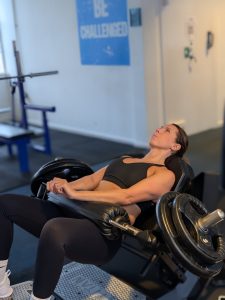
Exercises that safely put a significant amount of weight through your body are perfect for combatting the physical effects of perimenopause
When your muscles work against resistance, they place forces through your skeleton. Your bones respond to the demands placed upon them, which is one of the reasons progressive resistance training is such a useful part of maintaining bone strength.
In other words, your skeleton isn’t something you simply cross your fingers and hope for the best with. Training is one of the ways you can invest in it, and I’d much rather make that investment before bone health becomes an urgent concern. The ‘fix’ will only get harder to do as you get older.
Going All-In Doesn’t Mean Punishing Your Body
This is where I think the ‘go all-in’ message needs an important qualification. Going all-in on your health does not mean doing more and more exercise, hammering yourself with Bodypump sessions because your body has changed, trying to burn as many calories as possible or leaving every workout in a heap on the floor.
And it definitely doesn’t mean treating exercise as punishment because you don’t look exactly as you did at 25.
Going all-in means taking your physical health seriously. It means training with purpose rather than simply trying to make yourself tired. For strength training, that generally means using resistance that is challenging enough to give your body a reason to adapt, practising movements consistently and gradually progressing what you’re capable of doing.
That resistance might initially be your own bodyweight or a light dumbbell. As you become stronger, the loads you use should change with you. Eventually you might find yourself lifting weights you would once have considered impossible.
The starting point doesn’t matter nearly as much as the small improvements you begin to make.
You Don’t Need a Special ‘Perimenopause Workout’
This is another area where the fitness industry, and ambulance-chasing influencers, has a habit of making things unnecessarily complicated. Women in perimenopause don’t suddenly need an entirely new collection of exercises because their hormones are changing. The fundamentals of sensible strength training remain re-assuringly consistent.
A good programme will generally involve training the major muscle groups through movements such as squatting, hinging, pushing and pulling, using appropriate resistance for YOUR ability level and gradually becoming stronger over time.
What may change is how that programme is managed for the individual. If your sleep is terrible, recovery may need more consideration. If you’re experiencing joint discomfort, some exercises might need adjusting. If you’ve never trained before, you’ll need an appropriate starting point. If you already train seriously, there may be periods where performance doesn’t move upwards in a perfectly straight line.
That’s not a special perimenopause training system. That’s simply good coaching. The programme should fit the person being trained, not the last five people who walked through the door.
Cardio Is Good. But Strength Matters Too
Walking is brilliant. Running, cycling, swimming, dancing, tennis, padel and whatever else gets you moving can all have a place. Strength training doesn’t replace any of them, and this certainly isn’t an argument against cardiovascular exercise.
What I would question is the idea that cardio should constitute your entire approach to exercise. If you’ve spent years thinking of exercise almost exclusively as walking, running or attending cardio classes, you don’t necessarily need to stop doing any of those things. You may simply need to add something that deliberately challenges your muscles as well.
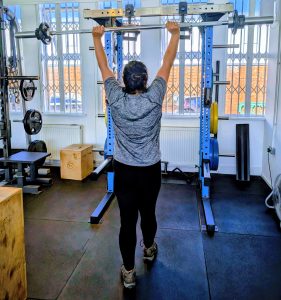
Simply doing cardio-based activities isn’t enough to challenge your body during this phase
Your cardiovascular fitness matters, but so do your muscles and bones. They aren’t competing priorities, and you don’t have to choose between them. In fact, being stronger can make many of the activities you already enjoy easier because you have more physical capacity available when you do them.
The gym doesn’t need to replace your hobbies. It can help you continue doing them.
What About Weight Gain During Perimenopause?
This deserves some care because it’s an area absolutely drowning in nonsense. Body composition can change through midlife, but the answer isn’t to panic, and it certainly isn’t to fall for somebody on social media claiming that one particular workout, supplement or diet will somehow ‘balance your hormones’ and restore your 25-year-old body in three weeks.
Strength training is useful because it helps you build and maintain muscle, and that’s valuable regardless of what the scales say. If changing your body composition is one of your goals, nutrition, overall activity, training, sleep and your individual circumstances all matter. There isn’t one magical perimenopause solution.
I’d also encourage women to think beyond simply weighing less. Being lighter isn’t the same thing as being stronger, fitter or healthier. If you’re thinking about the body you want to take into the next few decades, maintaining useful muscle and physical capability deserves a place fairly high on the priority list.
Your goal doesn’t have to be recreating the body you had when you were younger. Building a strong, capable body for the future is a much more useful target.
You Haven’t Missed Your Chance
Perhaps you’re reading this at 42 having never lifted a weight. Maybe you’re 48 and exercise has disappeared somewhere between work, children, caring responsibilities and everything else life has thrown at you. Perhaps you’re already experiencing perimenopausal symptoms and thinking that you should have started doing this ten years ago.
Maybe you should have. It doesn’t really matter now.
You don’t need to already be strong enough to start strength training, because getting stronger is the reason you’re starting. You don’t need to know what all the equipment does, walk into a gym already knowing how to squat or deadlift, or get yourself fit before you’re allowed to begin. You certainly don’t need to be the strongest, leanest or youngest person in the room.
You need an appropriate starting point and a programme that can progress as you do. Good strength training starts with what you can already do, and adds to it slowly. If you’ve never done it before, it’s not a reason not to start, it’s a reason to learn.
The Goal Isn’t to Become a Gym Person
The gym doesn’t have to become your life, and strength training doesn’t have to become your whole personality.
You might discover that you absolutely love lifting weights. Many women we train do. But you might simply see the gym as the place where you do the work that enables everything else you care about.
Perhaps what you actually love is walking, travelling, playing tennis or padel, skiing or cycling. Perhaps you want to keep running around with your children now and eventually your grandchildren. Maybe independence matters to you – carrying your own suitcase, getting yourself off the floor, gardening, walking up hills and being able to say yes to things without first wondering whether your body will cope.
That’s what we’re training for. The weights are simply the tool we use to build the physical capacity that supports the rest of your life.
Perimenopause Can Be a Wake Up Call
Nobody needs to pretend perimenopause is wonderful. For some women it can be incredibly disruptive, and if symptoms are affecting your life, it’s worth speaking to your GP about the options available. Exercise can be useful, but it isn’t a replacement for actual medical care where that’s needed.
But perhaps there is another way to look at this stage of life too. It can be a prompt, a reminder that your physical health isn’t something to continually push down the priority list until everything else has been dealt with. It can be the point where you decide the next few decades deserve some preparation.
Ageing isn’t simply something that happens to you while you stand on the sidelines. There are aspects of how you age that you can actively influence. You can train, become stronger, challenge your muscles, load your bones, maintain your fitness and continue learning what your body is capable of.
Most importantly, you can refuse to start unnecessarily shrinking your activity options.
This Is Not the Time to Start Giving Up
Perimenopause isn’t the beginning of the end of being physically capable. It isn’t an instruction to become more fragile, and it certainly isn’t the point where you have to start deciding you’re ‘too old’ for things.
If anything, it’s a reminder of how valuable your physical capability really is. The strength you build now isn’t just for what you can lift in the gym next month. It’s for where you want to be in ten, twenty or thirty years’ time.
Getting older isn’t something you need to fight, but don’t respond to perimenopause by automatically expecting less of yourself. Take it as an opportunity to become a bit more deliberate about how you treat your body.
Frequently Asked Questions About Perimenopause and Strength Training
Is strength training good during perimenopause?
Yes. Strength training can be particularly valuable during perimenopause because it helps maintain and build muscle and strength, while resistance and weight-bearing exercise can also support bone health. It can also help preserve the physical capacity you’ll want later in life.
How often should you strength train during perimenopause?
There isn’t one perfect frequency for everyone, but for many women, two or three well-planned strength sessions per week is a very sensible starting point. What matters most is that the training is appropriate for you, consistent and progressively challenging over time.
Should women lift heavy weights during perimenopause?
‘Heavy’ is relative. You don’t need to chase maximal weights, but the resistance does need to become challenging enough to stimulate adaptation. As you get stronger, weights that once felt heavy will become easier, and your training can progress accordingly.
Can you start strength training during perimenopause if you’ve never lifted weights before?
Absolutely. You don’t need to get fit or strong before you begin. Start at a level appropriate to your current ability, learn the movements properly and gradually progress from there.
Does strength training help with weight gain during perimenopause?
Strength training can help maintain and build muscle and can be an important part of managing body composition, but it isn’t a magic solution for weight loss. Nutrition, overall activity, sleep and individual circumstances matter too.
Is cardio or strength training better during perimenopause?
You don’t need to choose. Cardiovascular exercise and strength training offer different benefits and work extremely well together. Walking, running, cycling or other cardio can support cardiovascular fitness, while strength training specifically challenges your muscles and helps maintain strength and physical capacity. Many people find that their cardio ability improves through weight training.
Book your free Personal Training session today
If you’re in Nottingham and thinking about working with a personal trainer, this is the perfect opportunity to see what professional coaching can do.
Book your FREE personal training session and discover how expert guidance, a structured plan and genuine accountability can help you build strength, improve your fitness and achieve lasting results.
There’s no pressure and no hard sell. Just the opportunity to experience personal training for yourself, ask questions and see how we work.
After one session, you’ll know whether we’re the right gym, the right coach and the right approach for you.
Sign up to the RWF newsletter

