
What Does Lifting ‘Heavy’ Actually Mean in the Gym?
Just lift heavy.
It might be one of the most common pieces of advice in the fitness world.
Want to get stronger? Lift heavy. Want to build muscle? Lift heavy. Want to maintain muscle as you get older? Lift heavy. Going through menopause? Lift heavy. Worried about losing strength in later life? You guessed it. Lift heavy.
It sounds like straightforward advice, until you ask the obvious question.
What does heavy actually mean?
Does it mean lifting 100kg? Does it mean sets of five? Does it mean using the biggest dumbbells you can manage? Should every set feel horrible? And if you’re a 65-year-old beginner doing a 25kg leg press, does that count as heavy training?
The answer to that last question could quite easily be yes.
Because just like how fast you can make progress, heavy isn’t a number. It’s relative to you.
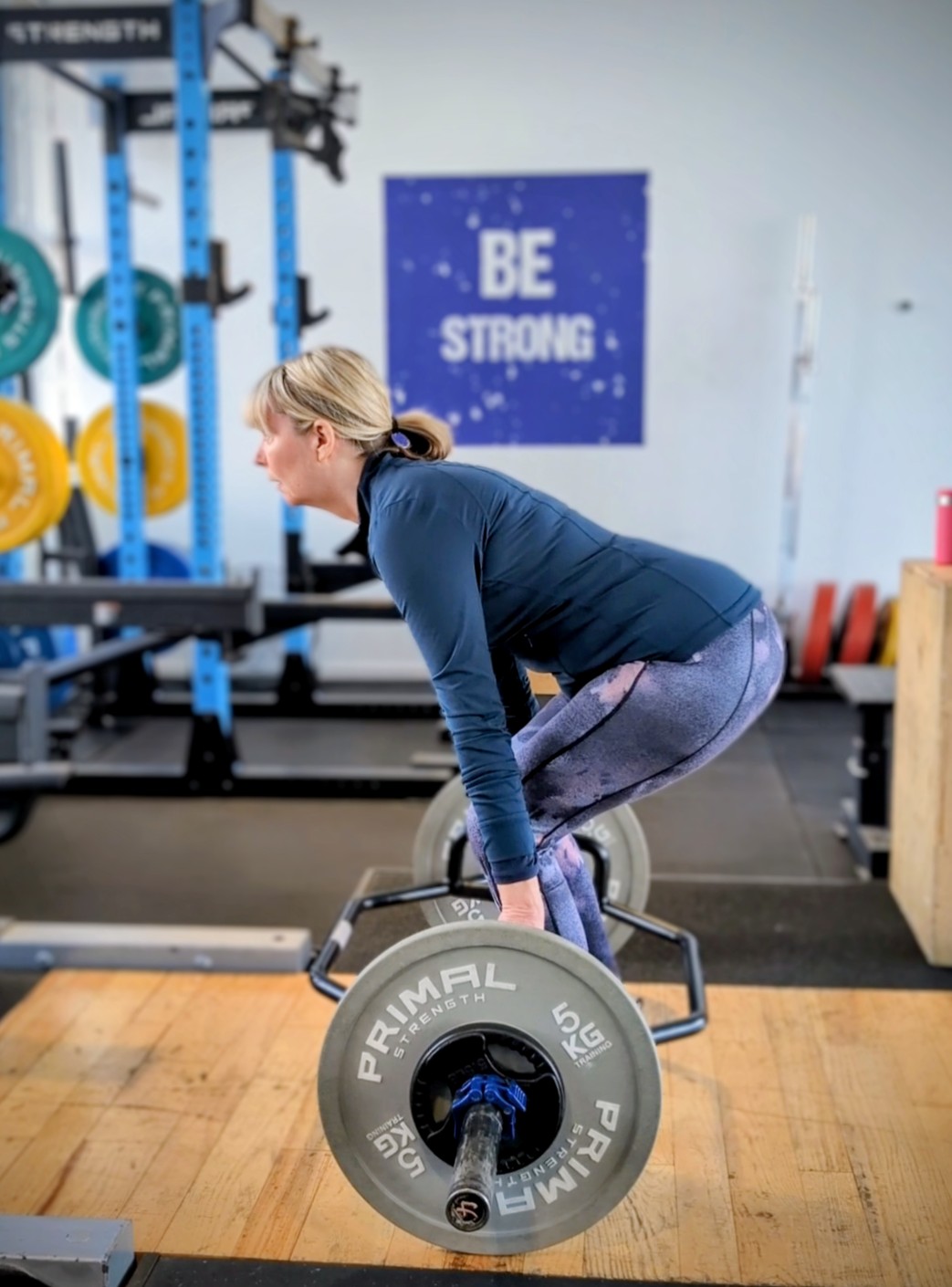
Brom had never lifted a weight in her life and was terrified of ‘heavy weights’. Now she’s lifting nearly her bodyweight in a deadlift.
A Weight Isn’t Heavy Until You Put It in Context
Imagine two people doing a goblet squat with a 20kg dumbbell.
The first person could comfortably perform 25 repetitions with it. They stop after eight.
The second person reaches eight repetitions and knows that, with good technique, they might have managed another one or two.
They’re lifting exactly the same weight, but they’re not doing anywhere near the same thing.
For the first person, 20kg is relatively light. For the second, it’s heavy enough to provide a significant training stimulus.
This is where simply talking about kilograms in isolation, and these social media ‘you should be able to lift X weight’ memes, becomes fairly meaningless.
A 100kg deadlift could be a warm-up for one person and a lifetime personal best for another. A 10kg dumbbell might be far too light for somebody’s squat but genuinely challenging for their shoulder press.
Even for the same person, the definition of heavy changes from exercise to exercise. No-one expects to bicep curl what they can deadlift.
So rather than asking whether a particular weight is heavy, the more useful question is how difficult is that weight for you to lift for the number of repetitions you’re doing?
Personal Training client Caroline strengthening her shoulders after an injury. She started on 1kg dumbbells, but now the 4kg ones are just as easy.
Heavy Doesn’t Mean Maximum
This is probably the biggest misunderstanding.
When we encourage people to lift relatively heavy weights, we’re very rarely telling them to lift the heaviest thing they possibly can.
There is an enormous difference between heavy training and maximal lifting.
A one-rep max is exactly what it sounds like – the greatest load you can lift once. Testing it can be useful in some circumstances, particularly for strength athletes (think powerlifting, strongman training and Olympic lifting), but you don’t need to regularly perform maximum lifts to get stronger.
And here’s another thing that is often considered beyond the pale by gym-goers who’ve never actually trained a real person – most people don’t need to perform them at all.
You can train very effectively using a weight that allows you to perform several controlled repetitions while still being genuinely challenging towards the end of the set. For a set of eight repetitions, for example, you might finish knowing that you could probably have completed another two repetitions if you absolutely had to.
That’s a heavy set. You haven’t failed. You haven’t needed somebody to rescue the bar. Your technique hasn’t fallen apart, but you also haven’t finished the set feeling as though you could have done another ten. Progress lies somewhere between ‘that was ok’ and ‘thank god I didn’t have to do another 3 reps’
If you perform ten repetitions but could realistically have done another ten, the weight is nowhere near your current limit. If you perform ten and could perhaps have managed another two, you’ve worked considerably harder. If the tenth repetition is genuinely the last repetition you could possibly perform, you’ve reached muscular failure.
You don’t have to reach failure on every set to make progress. In fact, for most of our clients at Real World Fitness, we usually don’t want that. You do need some understanding of where your limit actually is, and that can take time to learn.
Beginners are often surprised by just how many repetitions they still have available when they think a set has become difficult. The muscles start burning, breathing gets harder and suddenly the weight feels unpleasant. As trainers we’ll often see someone say ‘that’s too hard’, when we’re watching the set thinking this looks like a warm-up weight. That’s normal in the early days, as most people have no idea what their limit actually is.
Learning the difference between “this is getting difficult” and “I genuinely only have another repetition or two available” is an important training skill.
Heavy Can Be Eight Reps. It Can Also Be Fifteen.
This is another reason the phrase ‘lift heavy’ can be misleading.
People often associate heavy training exclusively with low repetitions, perhaps three, five or six reps.
Those are certainly useful rep ranges, particularly when developing maximal strength, but they aren’t the only way to provide a meaningful strength or muscle-building stimulus.
A set of 12 can be hard, and a set of 15 can be hard (and let’s not start on 20 rep squats!)
Even higher-repetition sets can become extremely demanding if they’re taken sufficiently close to your current capacity.
The experience is slightly different. Higher-repetition sets tend to involve more local muscular fatigue and discomfort, while very low-repetition training places greater emphasis on producing high levels of force against heavier absolute loads.
For general strength training, though, we don’t need to obsess over finding one magical repetition range. We need appropriate exercises, appropriate loads and sets that are sufficiently challenging to create a reason for the body to adapt.
We started Chris with a bar weighing just 20kg, and he struggled. Now he’s routinely squatting 100kg+ and wanting to try the next weights up.
What You See As Heavy Should Change
Suppose you start training and can squat 30kg for eight good repetitions, with perhaps another two repetitions available.
For you, at that moment, 30kg is a reasonably heavy training weight.
A few months later, you can perform eight repetitions with 30kg easily and could probably continue to 15.
The weight hasn’t changed, but you have, physically and mentally.
That 30kg is no longer providing the same challenge.
This is the basic principle behind progressive overload. As your body adapts to training, something eventually needs to progress. That might mean adding weight. It might mean performing another repetition. It might mean improving the range of movement or performing the exercise with better control.
But if exactly the same workout feels exactly the same, or easier, month after month, you shouldn’t expect your body to keep adapting. It’s probably one of the biggest things that stops people making any progress in the gym.
The aim isn’t simply to lift heavy. It’s to gradually become capable of lifting things that used to be heavy.
Heavy Should Still Look Like the Exercise
There’s another important qualification.
A weight only really counts if you’re still performing the exercise you intended to perform.
If your squat becomes progressively shallower every time you add weight, you’re not necessarily getting stronger through the same movement. If your dumbbell curl turns into a full-body swing, adding another 4kg hasn’t magically made your biceps stronger.
If somebody has to pull the bar off your chest on every bench press repetition, you’re not actually bench pressing that weight.
There will always be some variation in technique when an exercise becomes difficult. Nobody’s final repetition looks quite as effortless as their first, and it shouldn’t, but loading more weight should never become the sole objective.
The weight is there to challenge the movement, not make the movement almost impossible to do properly. That path leads to injury.
What About Older Adults?
This is where the language around heavy lifting can become particularly unhelpful.
We increasingly encourage older adults to perform resistance training, and rightly so. Maintaining muscle mass, strength and physical capacity becomes increasingly important as we age.
But telling a previously sedentary 70-year-old that they need to lift heavy can conjure up entirely the wrong image.
They don’t need to walk into a gym and start performing maximal barbell squats. Heavy is still relative. For somebody completely new to resistance training, a machine, dumbbell or even bodyweight exercise may initially provide plenty of resistance.
As they become stronger, that resistance can gradually increase.
The underlying principle is exactly the same whether you’re 25 or 75: the muscles need to encounter a challenge that they have a reason to adapt to.
What constitutes that challenge will be different for everybody, and importantly, it should change as they get stronger.
So How Heavy Should You Lift?
For most people training for general strength, muscle and healthy ageing, there’s a fairly simple practical answer.
Choose a resistance that allows you to perform your intended repetitions with good technique, but makes the final few repetitions genuinely challenging. Finish most working sets feeling as though you probably had a small number of good repetitions left rather than another entire set.
If you’re supposed to perform ten repetitions and you could easily have done 20, it’s probably time to increase the resistance. If you’re aiming for ten but your technique collapses at six, you’ve probably gone too heavy.
There’s a large useful area between those two extremes that WILL lead to progress.
Heavy Is Personal
One of the problems with gyms, and particularly social media, is that we’re surrounded by other people’s numbers.
Someone benches 140kg. Someone squats 200kg. Someone is doing walking lunges holding dumbbells twice the size of yours. None of that tells you what you should be lifting. In the nicest possible way, ignore them. They aren’t you.
Your training needs to be based on your strength, your experience, your technique and your goals.
If 15kg is genuinely challenging today, then 15kg is heavy.
If you train consistently and progressively, perhaps one day 15kg won’t be heavy anymore.
That’s the whole point. And I’ll let you in on a gym secret – the guy lifting the 50kg dumbbells is desperately wanting to get strong enough to lift the 55s. He has the exact same problem as you; he wants to hit the next weight up.
At Real World Fitness, we don’t want people chasing arbitrary numbers simply so they can say they lift heavy. We want them learning how to choose an appropriate resistance, perform the movement properly and gradually increase what they’re capable of doing.
Because ultimately, heavy isn’t a weight. It’s a relationship between the weight and the person lifting it, and good strength training is about gradually changing that relationship so you want (maybe even feel a psychological need) to try and lift a heavier weight.
Book your free Personal Training session today
If you’re in Nottingham and thinking about working with a personal trainer, this is the perfect opportunity to see what professional coaching can do.
Book your FREE personal training session and discover how expert guidance, a structured plan and genuine accountability can help you build strength, improve your fitness and achieve lasting results.
There’s no pressure and no hard sell. Just the opportunity to experience personal training for yourself, ask questions and see how we work.
After one session, you’ll know whether we’re the right gym, the right coach and the right approach for you.
Sign up to the RWF newsletter

