

Strength Training with Hypermobility: Is It Safe and How Should You Train?
If you are hypermobile, strength training can initially sound like something you should be cautious about.
Your joints already move further than most other people. You may have been told you are ‘double-jointed’, you might regularly click or clunk, or perhaps certain joints have always felt a little unstable. If you’ve also had repeated sprains, dislocations or joint pain, adding weights to the equation can understandably seem like a bad idea.

Being hypermobile doesn’t mean you can’t strength train – it often means you really should start!
In many cases, though, avoiding strength training altogether is probably the wrong approach.
One of the main ways we can help support a hypermobile joint is by making the muscles around it stronger and improving how well you control that joint. Improving muscle strength and fitness is a main part of managing symptomatic joint hypermobility. The important part is how you train.
What does being hypermobile actually mean?
Joint hypermobility simply means that one or more of your joints can move through a greater range than would normally be expected.
That isn’t automatically a medical problem. Plenty of people are naturally very flexible and never experience pain, instability or injury because of it. Hypermobility can even be useful in activities such as gymnastics and dance. Joint hypermobility on its own is more a physical characteristic than necessarily a disorder.
Things become more complicated when that additional movement comes with symptoms.
Some people have hypermobility spectrum disorder, usually shortened to HSD. Others have hypermobile Ehlers-Danlos syndrome, or hEDS. These conditions can involve much more than simply being flexible and can include joint instability, persistent pain, repeated injuries, fatigue and other symptoms.
A personal trainer should not be diagnosing any of those conditions. If somebody comes to us with unexplained repeated dislocations, significant pain or symptoms that suggest there may be more going on than simply being flexible, then we need to wait for an actual diagnosis rather than launching straight into a powerlifting training plan.
But once somebody has been assessed and exercise is appropriate, strength training can potentially be a very useful part of the picture.
Why can strength training help with hypermobility?
Your joints are supported by several different structures.
Ligaments and other connective tissues provide passive support. Muscles provide active support.

Strength training often helps to improve symptoms by taking some load away from tendons and ligaments
If passive structures allow a particularly large amount of movement, improving the strength and control of the muscles surrounding that joint can help you manage that movement more effectively.
Research in this area is still relatively small compared with conditions such as osteoarthritis, but what we do have is encouraging.
A 2022 systematic review examined exercise and rehabilitation studies involving people with Ehlers-Danlos syndrome and hypermobility spectrum disorders. Ten studies involving 330 participants were included. Every study reported some improvement in a physical and/or psychological outcome, although the researchers were clear that larger and better controlled trials are still needed.
So there is evidence for exercise. What we don’t yet have is a huge body of research telling us exactly how many sets, repetitions or kilograms every hypermobile person should lift. That is where sensible coaching and individual progression become important.
Hypermobility doesn’t necessarily mean weakness
This is worth making clear.
It is easy to assume that someone who is hypermobile must also be weak. That isn’t necessarily true.
A 2025 study comparing adults with and without generalised joint hypermobility found poorer awareness of what position the joint actually was in at the knee and elbow in the hypermobile group, but did not find poorer overall grip strength or functional performance.
The interesting part there is proprioception. Proprioception is essentially your ability to know where your body and joints are without needing to look at them.
If a knee can move further backwards than usual, for example, being able to accurately recognise and control its position becomes particularly useful. Being able to physically reach a position and being able to actively control that position are not quite the same thing.
This is one reason strength training for somebody with hypermobility shouldn’t simply be about adding more weight to the bar, because how much control you can exert is really important.
You don’t have to use every inch of your available range
This is probably one of the biggest practical differences when we train someone who is very mobile.
Your maximum possible range of movement does not automatically have to be your training range of movement.
Someone with very mobile knees may naturally stand with their knees pushed backwards into significant hyperextension. Someone with mobile elbows might do something similar at the top of a pressing movement.
Early on, we may deliberately work within a range where the joint is stable and the person can clearly control what is happening.
That doesn’t mean people with hypermobility should be frightened of their end range forever. In fact, there is some evidence from rehabilitation research that appropriately controlled exercise through a person’s available range can be useful. The issue is not simply whether the joint reaches the end of its range. It is whether the person has muscular control there rather than simply hanging on by your straining tendons.
Strength training should usually start with control, not load
No-one new to lifting needs to demonstrate how strong they are during their first few sessions.
With a hypermobile client, we are particularly interested in whether they can repeatedly produce the same movement.
Can they squat without the knees moving unpredictably? Can they press without aggressively snapping the elbows into their end position? Can they control their shoulder rather than allowing it to move wherever its available range takes it? Can they feel when their position changes?
If those foundations are there, resistance can gradually increase.
Guidance from the Ehlers-Danlos Society recommends beginning with relatively low loads and gradually progressing repetitions, weight and exercise duration according to the individual’s response. It also places a strong emphasis on movement control and strengthening the muscles responsible for joint stability.
That is not particularly exotic programming. It is actually very similar to how we would introduce strength training to most beginners.
Hypermobility just gives us yet another reason not to rush it.
Does that mean you should only ever lift light weights?
No.
This is where advice around hypermobility can become unnecessarily restrictive.
Starting conservatively is sensible. Remaining permanently on tiny weights because somebody once told you that you have ‘loose joints’ is a different thing altogether. If someone can perform an exercise consistently, their joints are tolerating it, symptoms remain settled and their strength is improving, there is normally a progression to be made.
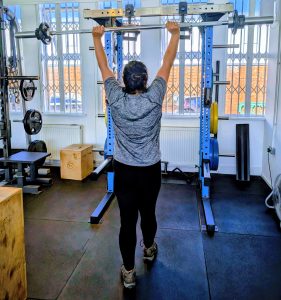
There’s no reason a hypermobile client can’t lift like everyone else – we just have to be careful and load progressively, like with any other person
That might mean another repetition. It might mean slightly more resistance. It might mean moving from a supported exercise to one demanding more balance and joint control. Eventually it can mean lifting reasonably substantial weights.
The current research does not give us enough evidence to claim that heavy resistance training is appropriate for every person with HSD or hEDS. Equally, there isn’t good evidence for an arbitrary weight limit that applies to everyone with hypermobility.
The person’s ability in training matters more than the label. There are exceptions, though. Certain connective tissue disorders carry specific risks. People with vascular Ehlers-Danlos syndrome, for example, are advised to avoid heavy lifting and activities that cause large increases in blood pressure. Anyone with a diagnosed connective tissue disorder like this needs to follow their doctor’s advice, not a PT (even one as competent as RWF!).
Machines or free weights?
Both can be useful.
A machine can sometimes be an excellent starting point because it removes some of the movement possibilities and allows somebody to concentrate on producing force through a more predictable path.
A leg press may suit one person better than a squat initially. A supported row may be easier to control than a bent-over free-weight variation. A machine chest press may allow someone to build pressing strength while they learn how to manage a particularly mobile shoulder.
That does not make machines inherently safer, nor does it make free weights dangerous.
As control improves, free weights can provide something useful precisely because they require the person to stabilise and control more of the movement themselves.
The question isn’t really ‘machines or free weights?’, it is ‘which exercise gives this person the right challenge at this stage?’
Feeling tight when you’re hypermobile
This surprises people.
Someone can be hypermobile and still feel extremely tight.
Muscles surrounding a joint may be working hard to provide stability, and that can create a persistent feeling of tension. Constantly trying to stretch those muscles further is not necessarily the answer.
The Ehlers-Danlos Society specifically warns against excessive stretching in people with EDS and HSD because overstretching can increase instability.
So if you are already extremely mobile, don’t automatically assume every feeling of tightness requires more flexibility work. Sometimes what your body actually needs is more strength and control.
Proprioception deserves some attention too
Strength isn’t the whole story.
One study used closed-chain exercises with people who had joint hypermobility syndrome. Participants improved knee proprioception, balance, quadriceps and hamstring strength, while also reporting reductions in pain and improvements in quality of life.
A later randomised clinical trial also found improvements in knee proprioception after a programme combining closed-chain and proprioceptive exercises.
In a gym, that doesn’t necessarily require an elaborate collection of unstable surfaces.
A controlled split squat, step-up, single-leg exercise or slowly performed squat can all require you to recognise and control joint position.
What if exercise causes pain?
Hypermobility doesn’t mean every ache is dangerous, but neither should persistent joint pain simply be ignored.
There is a difference between muscular fatigue after training and a joint repeatedly becoming painful, swollen or unstable. If a particular movement consistently aggravates a joint, we change it. That could mean reducing the range, reducing the resistance, changing the exercise or temporarily removing it.
If symptoms are new, severe, getting progressively worse or involve repeated subluxations or dislocations, that is no longer simply a programming question. It needs appropriate assessment.
At Real World Fitness, our role is strength and exercise coaching. We can work alongside advice from a physiotherapist or other healthcare professional, but we don’t pretend to be a substitute for them.
Training the person rather than the condition
Two people can both describe themselves as hypermobile and require completely different programmes.
One might have no pain at all and simply need a little more attention to controlling their knees and elbows when they lift. Another might have diagnosed hEDS, a history of shoulder instability, fatigue and several previous dislocations.
Giving those two people the same generic ‘hypermobility workout’ would make very little sense.
This is where individual personal training can be particularly useful. We train YOU, and we work around your condition.
Exercise selection, range of movement, starting loads, progression and training frequency can all be adjusted according to how you move and how your body responds. The aim isn’t to turn a hypermobile person into somebody who is no longer hypermobile, it’s to make them stronger and more capable of controlling the body they already have.
Should you strength train if you’re hypermobile?
For many people, yes.
Hypermobility by itself is not a reason to avoid the gym. Even for people with symptomatic hypermobility, appropriately planned strengthening exercise forms an important part of current management advice. The NHS, physiotherapy guidance and the available research all point towards maintaining and developing strength rather than simply becoming less active.
The programme might need more thought.
You may initially use a slightly smaller range of movement. You may progress weight more gradually. Certain joints may need more stability work. Some exercises may suit you far better than others, but none of that means you can’t get stronger.
For many hypermobile people, getting stronger is actually part of the solution.
Frequently Asked Questions
Is weight training safe if I am hypermobile?
For many people, yes. The programme should reflect your symptoms, joint stability, training history and any diagnosed medical condition. Starting conservatively and building strength and movement control gradually is generally preferable to avoiding resistance training altogether.
Can strength training stop my joints being hypermobile?
Strength training will not change the underlying connective tissue or necessarily reduce the range your joints are capable of reaching. What it can improve is the muscular support and control around those joints.
Should I avoid locking my knees and elbows?
Not everyone needs to avoid full joint extension permanently. The important issue is control. If you habitually push well beyond neutral and hang on the end of a hypermobile joint, it may be useful to learn greater muscular control of that position and initially train within a range you can manage consistently.
Are machines better than free weights for hypermobility?
Not automatically. Machines can be useful when additional support makes an exercise easier to control, while free weights can later provide a useful stability challenge. Exercise choice should depend on the individual.
Should hypermobile people stretch?
Being hypermobile doesn’t mean every muscle is flexible or that stretching is forbidden. However, repeatedly forcing already mobile joints further into their range may increase instability. Stretching should have a specific reason rather than simply trying to become more flexible.
Can I lift heavy weights if I have hEDS?
There isn’t enough research to give everyone with hEDS a universal safe weight or intensity. Training needs to be individualised and progressed according to joint stability, symptoms and medical advice. Other types of EDS can carry different risks, so a confirmed diagnosis matters.
Should I see a physiotherapist before starting?
If you have significant pain, recurrent dislocations or subluxations, unexplained instability, a diagnosed connective tissue disorder or uncertainty about your symptoms, getting appropriate medical or physiotherapy advice first is sensible. A personal trainer can then work within that advice to develop your strength.
Book your free Personal Training session today
If you’re in Nottingham and thinking about working with a personal trainer, this is the perfect opportunity to see what professional coaching can do.
Book your FREE personal training session and discover how expert guidance, a structured plan and genuine accountability can help you build strength, improve your fitness and achieve lasting results.
There’s no pressure and no hard sell. Just the opportunity to experience personal training for yourself, ask questions and see how we work.
After one session, you’ll know whether we’re the right gym, the right coach and the right approach for you.
Sign up to the RWF newsletter

