
Over-70s Strength Training In Nottingham
Looking for a personal trainer in Nottingham as someone in their 70s or 80s? At Real World Fitness, we work with older clients whose abilities, interests and reasons for training vary enormously. Here’s how we approach it.
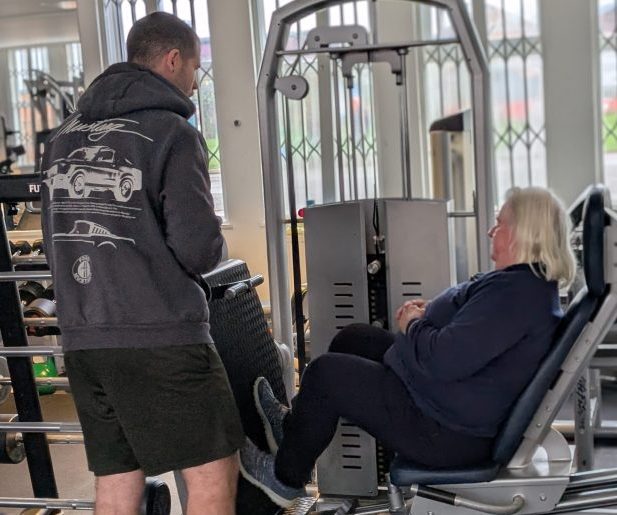
One of our PT’s Joe helping his client use the leg press for the first time at RWF
What does being in your 70s or 80s actually tell us about your fitness?
Not nearly as much as you might think.
At Real World Fitness in Nottingham, we currently have around seven or eight personal training clients in their 70s and 80s. It’s a reasonable little group to draw some observations from, and perhaps the most interesting thing is just how different they all are.
We have clients who have experienced significant mobility problems, including two who’ve dealt with extensive joint issues and who, with appropriate support and training, have progressed from being unable to walk without assistance to walking without a frame.
At the other end of the scale, we have clients taking up sports such as padel and pickleball, others who enjoy playing badminton regularly, and people who simply want to stay fit and continue doing the things they’ve always enjoyed.
Some want to become more active. Others are already very active and would like to stay that way. Some have absolutely no interest in playing sport or going on long walks. They just want everyday life to remain manageable.
All of these people are in roughly the same age bracket, and all of them have very different requirements from a personal trainer.
It’s something we’ve noticed increasingly over the years. As people get older, the difference between what one person can physically do and what another person of the same age can manage can become enormous.
That’s why we don’t have a standard training programme for 70-year-olds. Everything we do is bespoke to the individual.
You’re over 70, not necessarily elderly
One of the difficulties with talking about exercise for older adults is the terminology.
Some people in their 70s are perfectly comfortable being described as elderly. Others would find the suggestion rather ridiculous, particularly if they’ve just come back from playing three sets of tennis.
There’s a genuine difference between being older and being frail. Ageing does bring physical changes. We tend to lose muscle mass and strength over time, recovery can become slower, and existing health conditions may complicate things.
But none of that tells us precisely what you can do today, or what you could be capable of six months from now.
We’ve worked with people in their 70s who need significant assistance with quite basic movements, and others who are perfectly capable of lifting challenging weights and participating in demanding sports. It would be equally inappropriate to give both groups the same programme. It would also be wrong to assume that somebody who isn’t particularly active wants to become a gym enthusiast.
For some people, personal training is about improving sporting performance. For others, it’s about being able to get out of a chair comfortably, carry the shopping or walk to the local shops without worrying about their balance.
Neither is a more legitimate reason to train.
Why the differences become more noticeable as we age
Think about two people who are both 30 years old.
One has spent the last decade playing sport and exercising regularly. The other has been largely inactive. There will probably be differences in their strength and fitness, but both may still be able to manage most everyday activities without much difficulty.
Now imagine those same people at 75.
Over another 45 years, differences in exercise habits, muscle strength, injuries, illness, lifestyle and general health can add up considerably.
One person might still be enjoying regular sporting activity, while the other has gradually lost the strength and mobility needed for things they previously took for granted.
Of course, it’s not always as straightforward as that. Someone who has been active all their life can develop serious health problems, while somebody who starts exercising much later can make very worthwhile improvements.
The point is that the older we get, the less useful age alone becomes when deciding what exercise someone should be doing.
Personal training at 70 isn’t necessarily all gentle exercise
One concern we sometimes encounter is the assumption that personal training for older people means sitting in a chair, lifting very light weights and doing a few stretches.
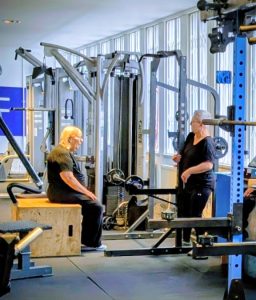
Personal trainer Christine helping an older client learn to squat to improve her leg strength
Sometimes seated exercises are entirely appropriate. If somebody has significant balance difficulties, very limited mobility or is recovering from a serious health problem, supported movements can be an excellent place to begin.
But we wouldn’t use that approach simply because somebody happens to be 73.
If you’re capable of doing squats, we’ll consider squats. If you can safely use resistance machines or free weights, we’ll use them. If you’re interested in improving your strength for badminton or pickleball, your training should reflect that.
Equally, if you currently struggle to walk confidently, we aren’t going to expect you to start lifting heavy barbells.
The exercises, equipment, resistance and pace of progression all depend on your current ability and what you’re trying to achieve. We want training to be challenging enough to produce improvement, without asking people to do things they aren’t ready for.
That’s exactly where experienced personal training can be helpful – and we’ve been doing this for over 20 years.
What if you’ve got arthritis, joint replacements or other health problems?
By the time someone reaches their 70s, there’s a reasonable chance they’ve collected a few aches, injuries or medical conditions along the way.
Arthritis, previous joint replacements, osteoporosis, cardiovascular conditions, diabetes and problems with balance are all things we might need to consider.
Sometimes several of these are present together.
That doesn’t automatically mean exercise is unsuitable. Often, appropriately prescribed exercise can help people manage their physical limitations and retain strength, but it does mean we need to understand what’s going on.
For example, somebody with a knee replacement may be perfectly capable of developing excellent leg strength. They may simply need a different selection of exercises, or a different starting point, from somebody who has never had knee surgery.
Someone with osteoporosis may benefit from resistance training but require additional care over exercise selection, spinal loading and movements that could increase fracture risk. A person with a history of falls might initially benefit more from improving lower-body strength, balance and walking confidence than from conventional gym-based fitness work.
Where appropriate, we’ll work within advice provided by a GP, physiotherapist or other healthcare professional. Unexplained symptoms, recent medical events or unstable conditions obviously need medical assessment before exercise begins. We don’t pretend that personal training replaces medical treatment.
What we can do is help people exercise appropriately around their circumstances, and make progress when doing so is safe.
Strength training can be particularly valuable in your 70s
One of the biggest physical changes associated with ageing is the gradual loss of muscle mass and strength.
This is often referred to as sarcopenia, and we’ve written about it in more detail in our Knowledge Centre.
It’s particularly relevant because muscle strength affects considerably more than how much weight you can lift in a gym. It influences how easily you can climb stairs, rise from a low chair, recover your balance, carry things and generally move around.
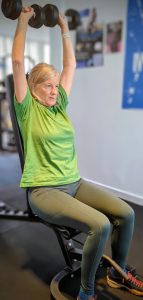
Personal Training client Caroline strengthening her shoulders after an injury. She started on 1kg dumbbells, but now the 4kg ones are just as easy.
As strength decreases, everyday activities can become harder. People then often begin avoiding those activities, become less active and lose even more physical capacity. Proper strength training can help interrupt that process.
The NHS recommends that adults aged 65 and over include activities to improve strength, balance and flexibility at least twice a week, alongside regular physical activity. These recommendations aren’t restricted to people who already consider themselves fit. It’s worth remembering that starting later doesn’t mean you’ve missed your opportunity. People can improve strength and physical function well into older age.
What do our older personal training clients actually work on?
The answer is almost everything you would expect from personal training with younger adults, along with some priorities that become more common as we get older.
For somebody with limited mobility, we might concentrate on leg strength, getting up and down safely, improving balance and gradually increasing how far they can walk.
For another person, it might be conventional resistance training using machines, dumbbells and barbells, with progressive increases in difficulty as they become stronger.
For our clients who play badminton, padel or pickleball, there may be more emphasis on leg strength, moving confidently around the court, maintaining balance and building the physical capacity to keep playing.
And for somebody whose main aim is simply to stay fit and independent, we might use a combination of strength exercises, cardiovascular work and movements that help with daily activities.
We don’t need everyone to have an ambitious goal. If your objective is to continue living independently, look after your home, go on holiday and enjoy life without unnecessary physical restrictions, that’s plenty for us to work with.
Starting exercise at 70 versus continuing exercise at 70
This is another distinction worth making.
Someone who has exercised regularly for 30 or 40 years is unlikely to need the same introduction to training as someone who has never set foot in a gym.
An experienced lifter doesn’t suddenly need to abandon their usual exercises because they’ve turned 70. We might need to consider recovery, existing injuries or medical conditions more carefully, but the basic principles of strength training haven’t changed.
On the other hand, someone starting for the first time may need a much more gradual introduction. That could involve learning how to use resistance machines, developing confidence with particular movements, and discovering what level of exercise feels manageable. There’s no expectation that a complete beginner will train in the same way as someone who’s been exercising for decades.
Both can benefit from expert personal training. They simply need different approaches.
What if you’re looking for a personal trainer for your Mum or Dad?
We also understand that sometimes it’s a family member making the initial enquiry.
Perhaps you’ve noticed a parent struggling with stairs, becoming less confident walking outdoors or gradually reducing how much they do.
It’s natural to wonder whether exercise could help, and sometimes it can, considerably.
One thing we’d encourage is involving your parent in the conversation from the beginning. They may have very different priorities from yours. You might be worried about them falling. They might simply want to feel confident walking to the shops again.
You might think they need to become much fitter. They might be quite happy with their current lifestyle and only want to maintain their independence.
There’s also an important difference between helping somebody who wants to exercise and trying to persuade somebody into an activity they really don’t want to do. We’d much rather find out what they personally want to achieve and build from there.
What happens at your first personal training appointment?
We offer a free initial personal training consultation at Real World Fitness.
It’s an opportunity to meet one of our trainers, see the gym, explain what you’re looking for and talk through anything that might affect your training.
We’ll ask about your health, previous exercise experience, any existing problems and what you’d like to improve.
If it’s appropriate, we might briefly look at a movement or two to help us understand your starting point, but we aren’t going to put you through a full workout on your first visit, and there’s no expectation that you need to prove how fit you are.
The important thing is establishing whether we can help, what that help might look like, and whether you’re comfortable with our approach.
Personal training sessions start at £50, and you don’t need to become a gym member to work with one of our trainers.
Personal training for over-70s in Nottingham
Real World Fitness is based in Colwick, Nottingham, with free parking and a quiet, well-equipped training environment.
Our personal trainers work with a wide range of clients, including people in their 70s and 80s with very different levels of fitness and mobility.
Some of those clients have made significant improvements in their ability to manage everyday activities. Others are using their training to continue enjoying an active lifestyle, and some simply want to know they’re doing something useful to look after themselves as they get older.
There’s no single way a person in their 70s should look, move or exercise.
We’d rather find out what you can do, what you’d like to be able to do, and how we might help you get there.
If you’re considering personal training for yourself or a family member, get in touch to arrange a free initial consultation.
You can find out more about our personal training in Nottingham, or contact us to arrange a visit.
Frequently asked questions
Am I too old to start personal training at 70?
No. Your age alone doesn’t determine whether personal training is suitable. Your current health, mobility, experience and goals are much more useful considerations. If you have significant health concerns or haven’t exercised for a long time, it’s sensible to speak with your GP before starting.
Can an 80-year-old benefit from strength training?
Yes. People in their 80s can still improve strength and aspects of physical function. The exercises and achievable improvements will depend on their individual circumstances.
What if I have difficulty walking or use a walking frame?
That doesn’t automatically prevent you from doing appropriate exercise. We’ve worked with clients who have experienced considerable mobility difficulties. We’d assess your circumstances carefully and establish whether personal training is appropriate, potentially alongside advice from a physiotherapist or other healthcare professional.
Will I have to lift heavy weights?
Not unless it’s appropriate for your ability and goals. Resistance training can use body weight, supported movements, machines, dumbbells or barbells. What we choose depends on you.
Can personal training help me continue playing tennis, badminton, padel or pickleball?
Yes. Strength and balance training can help support the physical demands of these sports. We already work with older clients who enjoy racket sports and want to continue participating.
Do I need to join the gym to have personal training?
No. Personal training at Real World Fitness is available independently of gym membership.
How much does personal training cost?
Personal training sessions start at £50. Your first consultation is free, giving you a chance to discuss your needs before committing to sessions.
Ready to Start Strength Training?
You don’t need to love gyms, and you don’t need past experience. You just need to take the first step, and we’ll help you do that.
At Real World Fitness, we’ll help you build strength, protect your independence, and feel better than you thought possible at 60+.
👉 Click below to book your free consultation and let’s show you how simple and enjoyable this can be.


Book a free Personal Training session today
If you’re in Nottingham and thinking about working with a personal trainer, this is the perfect opportunity to see what professional coaching can do.
Book your FREE personal training session and discover how expert guidance, a structured plan and genuine accountability can help you build strength, improve your fitness and achieve lasting results.
There’s no pressure and no hard sell. Just the opportunity to experience personal training for yourself, ask questions and see how we work.
After one session, you’ll know whether we’re the right gym, the right coach and the right approach for you.
Sign up to the RWF newsletter

