

Paddleboarding Without Pain: How to Prevent Shoulder, Back and Wrist Injuries on the Water
Stand-up paddleboarding has exploded in popularity over the last few years, and it’s easy to understand why.
It gets you outdoors, it’s relaxing, and it’s surprisingly good exercise without feeling like quite like a workout. Whether you’re gliding along the Trent, exploring the Norfolk Broads or heading out on the coast during your holidays, paddleboarding has a habit of making people forget they’re exercising at all.
That’s one of its biggest strengths, but it’s also one of the reasons people get caught out.
Many of the people taking up paddleboarding are in their 30s, 40s, 50s and beyond. They might be reasonably active. They may walk regularly, go to the gym a couple of times a week or enjoy cycling. But they’ve never spent two hours repeatedly reaching forwards, driving a paddle through the water and balancing on an unstable surface.
The result? Sore shoulders. A stiff lower back. Aching wrists. Sometimes a neck that feels like you’ve slept upside down on a sofa all night.
The encouraging news is that these problems are rarely a sign that paddleboarding isn’t for you. More often, they’re a sign that your body simply isn’t used

Paddleboarding is mainly done ON the board 🙂
to the demands of a new activity. With a little preparation, sensible progression and some targeted strength work, most people can continue enjoying paddleboarding pain-free forever.
Why Paddleboarding Causes Aches
One of the biggest misconceptions about paddleboarding is that it’s all about the arms, but watch an experienced paddler and you’ll notice something very different.
The paddle is simply the connection between the body and the water. Like many sports, the power starts in the legs, travels through the hips, across the core and into the shoulders before finally reaching the paddle.
Beginners, as with other sports, often do the opposite. They stand quite stiffly, reach forwards with the arms and try to pull themselves through the water using their shoulders and biceps.
It works, for a while, especially if you have a lot of upper body strength built in the gym.
But, eventually those smaller muscles become tired, technique deteriorates and more stress ends up going through the shoulders, elbows and wrists than they were designed to cope with.
Add in a slightly windy day, a larger board that’s difficult to steer or a few hours exploring with friends and you’ve suddenly performed hundreds, perhaps thousands, of repetitive strokes. Overuse injuries then become pretty predictable.
The Most Common Paddleboarding Injuries
Fortunately, paddleboarding isn’t a high-impact sport.
You’re unlikely to be dealing with the twisting knee injuries associated with football or the repeated pounding that runners sometimes experience.
Instead, the problems tend to come from doing the same movement over and over again (repetitive strain injuries, or RSI’s)
Shoulder Pain
This is probably the most common complaint.
The shoulder works hard every time the paddle enters the water. If your upper back is stiff, your shoulder blades don’t move well or your rotator cuff lacks strength, the shoulder joint can gradually become irritated.
Many people notice discomfort when reaching forwards or lifting the paddle overhead after a longer session.
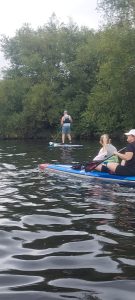
The longer you stay fit and injury free, the more exploring you can do
Lower Back Pain
The lower back often ends up doing a job that belongs to the hips and upper back.
Rather than rotating through the whole body, beginners frequently twist from the waist while keeping their hips almost completely still.
Multiply that movement by several hundred paddle strokes and it’s easy to understand why the back starts complaining.
Wrist and Forearm Pain
Gripping the paddle too tightly is incredibly common.
Many beginners hold it as though it’s a second life-jacket.
A constant death grip places unnecessary stress through the wrists and forearms, particularly if you’re paddling into a headwind or trying to keep up with more experienced friends.
Neck Tension
If your shoulders slowly creep towards your ears throughout a session, your neck muscles spend hours working overtime, and your traps can feel like they’re on fire for days afterwards.
At the very least, that dull ache across the tops of the shoulders the following day is often the result.
The Biggest Beginner Mistakes
The first is simply doing too much.
Buying a paddleboard is exciting. It’s easy to find yourself spending three or four hours on the water during the first sunny weekend because you’re enjoying yourself so much.
Your cardiovascular fitness might cope perfectly well, but your muscle and tendons may not.
The second mistake is trying to generate all the power through the arms. Good paddling is surprisingly athletic. The legs create stability, the hips rotate, the core trunk transfers force and the shoulders guide the paddle.
When those larger muscle groups all contribute properly, the smaller joints don’t have to absorb nearly as much stress.
The third mistake is believing soreness means you’re just getting fitter. Some muscle fatigue is perfectly normal when learning a new activity. Sharp shoulder pain, increasing back pain or symptoms that become worse every time you paddle deserve attention before they develop into a long-term problem.
A Five-Minute Warm-Up Before You Launch
Most people carry their board from the car park, put it on the water and start paddling.
Your body would appreciate a little more notice, and you’ll get a lot more of your session. Spend a couple of minutes walking briskly while carrying or setting up your equipment.
Perform ten slow shoulder circles forwards and backwards.
Rotate gently through your upper back by folding your arms across your chest and turning from side to side.
Move your wrists through comfortable circles in both directions.
Perform ten bodyweight squats.
Finish by rehearsing ten slow paddle strokes before stepping onto the board.
Five minutes is enough. You’re not trying to become more flexible. You’re simply preparing your muscles and joints for what’s about to happen and dropping your chances of injury immensely.
Strength Training That Makes Paddleboarding Easier
One of the nicest surprises for many clients is discovering that getting stronger often makes paddleboarding feel easier rather than harder.
People imagine they need powerful shoulders. Actually, they just need an efficient body.
Rows strengthen the upper back and help support the shoulder blades. Lat pulldowns develop the muscles that help control each paddle stroke. Romanian deadlifts build the hips and posterior chain that generate force. Farmer’s carries improve grip endurance without endlessly squeezing a paddle.
Single-arm pressing develops shoulder stability. Rotational core exercises teach the trunk to transfer force instead of asking the lower back to do all the work. Single-leg balance exercises improve stability on the board itself.
None of these exercises exist to replace paddleboarding. They simply prepare your body to enjoy it more – and if you can concentrate on technique more than worrying that you’re too weak, you’ll have way more fun on the board.
Can You Keep Paddleboarding If Something Starts Hurting?
Usually, yes.
One slightly sore shoulder after your first trip doesn’t necessarily mean you should pack the board away for the rest of the summer. Often, reducing the distance, taking more frequent breaks or paddling for an hour instead of three allows symptoms to settle while your body adapts.
The important question isn’t whether you have absolutely no discomfort, it’s whether your body is coping with the amount you’re asking it to do.
If the ache settles within a day and gradually improves over the following days, you’re probably moving in the right direction. If every trip leaves you worse than the last, or the pain starts affecting sleep or everyday activities, it’s time to investigate what’s going on.
Recovery Starts When You Get Off the Water
Many people finish paddling and immediately climb into the car for a two-hour drive home.
Your body tends to stiffen up remarkably quickly, so spend five minutes walking.
Move your shoulders through their range. Rotate gently through your upper back. Drink some water – sounds obvious, but in the rush to pack up and get everything home it can be hours before you realise you’re thirsty. Water kickstarts all recovery, so don’t skimp on it.
If you’ve been out for several hours, have something containing protein and carbohydrate rather than waiting until late evening.
Simple habits like these often make a surprising difference the following morning.
How the gym actually makes a difference to sport
One of the things I’ve noticed over the years is that clients don’t often come to me because they want to become brilliant at squats or deadlifts.
They come because they want to keep doing something else.
That might be skiing with their family, or playing golf twice a week, or getting back on a bike after twenty years.
Or, increasingly, spending weekends on a paddleboard without their shoulders aching for three days afterwards.
The weights are simply the tool. The real goal is always the activity they care about.
That’s exactly how I think strength training should work. The gym is the 9-5 you put in to be able to enjoy the weekends. What’s better about this analogy is that you don’t have to do more than a couple of 45 minutes sessions a week (not 37.5hrs!) to get most of the benefits. So, even if you don’t enjoy gym work, think of it like a job to facilitate your hobby, and just get it done.
Exercise shouldn’t become the hobby that replaces all your other hobbies. It should give you the confidence and physical capacity to enjoy them for longer.
Whether that’s paddleboarding, padel, hiking, cycling or simply exploring somewhere new on holiday, building strength makes your body more resilient.
You recover more quickly, and you can tolerate more activity. Little aches are much less likely to become long-term injuries.
Most importantly, you spend more time doing the things you actually enjoy.
At Real World Fitness in Nottingham, that’s exactly how we approach strength training. Not always as an end in itself, but as the foundation that lets you keep saying being able to have fun, stay active and enjoy sports without worrying about your capabilities.
Frequently Asked Questions
Is paddleboarding good exercise?
Absolutely. It improves balance, works most major muscle groups, challenges your cardiovascular system and gets you outdoors, all while feeling enjoyable rather than repetitive.
Why do my shoulders hurt after paddleboarding?
Usually because they’re working harder than they need to. Limited upper-back mobility, weak shoulder muscles, poor technique or simply doing too much too soon can all contribute.
Should my lower back ache after paddleboarding?
A little muscular fatigue is normal when you’re new to the sport. Persistent or increasing back pain usually suggests you’re relying too heavily on your lower back instead of using your hips and trunk effectively.
Can strength training improve paddleboarding?
Definitely. Stronger hips, shoulders, upper back and core help transfer force more efficiently, making each paddle stroke feel easier while reducing stress on the smaller joints.
How often should beginners paddle?
One or two sessions a week is usually enough to allow your body to adapt. You can always increase the frequency once your shoulders, wrists and back have developed the capacity to cope.
Do I need to stop if something starts hurting?
Not always. Mild discomfort that settles within 24 hours often responds well to reducing distance, taking more breaks and gradually building strength. Pain that becomes progressively worse or starts affecting daily life should be assessed.
If you’re based in Nottingham and would like to learn how strength training could help you feel stronger, healthier and more confident, book a free personal training session. We’ll discuss your goals, answer your questions and show you how the right programme can help you get more out of life, both now and in the years ahead.
If you’d like to see what we’re about, get in touch or arrange a free 7-day trial.
Book your free Personal Training session today
If you’re in Nottingham and thinking about working with a personal trainer, this is the perfect opportunity to see what professional coaching can do.
Book your FREE personal training session and discover how expert guidance, a structured plan and genuine accountability can help you build strength, improve your fitness and achieve lasting results.
There’s no pressure and no hard sell. Just the opportunity to experience personal training for yourself, ask questions and see how we work.
After one session, you’ll know whether we’re the right gym, the right coach and the right approach for you.
Sign up to the RWF newsletter

