

Frozen Shoulder: What Is It, What It Probably Isn’t, and How to Keep Training
Frozen shoulder is one of those terms that gets used far more often than it probably should.
Someone develops shoulder pain, loses a bit of movement and before long they have either diagnosed themselves with a frozen shoulder or been told by somebody else that this is what they have.
Sometimes they are right, but a genuine frozen shoulder, also known as adhesive capsulitis, has a fairly distinctive feature: the shoulder doesn’t just hurt when you try to move it. The joint itself becomes severely restricted.
The distinction is very important, because plenty of other shoulder problems can make lifting your arm painful without actually stopping the shoulder joint from moving.
It also matters when it comes to exercise. A painful rotator cuff, a frozen shoulder, arthritis and pain referred from the neck are not necessarily things we would train around in exactly the same way.
This article isn’t intended to turn you into your own physiotherapist. It should, however, give you a much better idea of whether what you are experiencing sounds like a frozen shoulder, and what sensible strength training can look like while it improves.
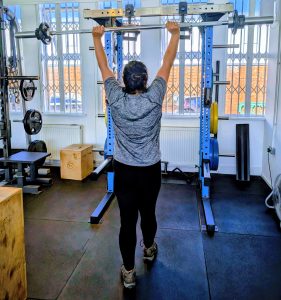
If you can get your shoulder above your head under load, it’s almost certainly NOT frozen shoulder
What actually is a frozen shoulder?
Your shoulder is a ball-and-socket joint surrounded by a capsule of connective tissue. In frozen shoulder, that capsule becomes inflamed, thickened and contracted. The result is pain followed by a substantial loss of movement.
It most commonly affects people between roughly 40 and 70 and is associated with several factors including diabetes, thyroid disease, previous shoulder injury, surgery and periods where the arm has had to be immobilised. Sometimes there is no obvious reason at all.
Traditionally, frozen shoulder has been described as going through three stages: freezing, frozen and thawing.
That description is useful up to a point, but real life is rarely quite so delineated. Pain and stiffness can overlap considerably, and research has challenged the old assumption that everybody progresses predictably through those stages and eventually makes a complete spontaneous recovery.
For training purposes, it is probably more useful to think about how painful, irritable and restricted the shoulder is right now.
Someone whose shoulder is extremely painful at night and reacts badly to relatively small movements needs a different approach from somebody whose pain has largely settled but who is still struggling to get their arm overhead.
The biggest clue: active movement versus passive movement
This is probably the most useful part of the article if you are wondering whether your shoulder might actually be frozen.
Imagine trying to raise your affected arm above your head.
If you physically cannot lift it very far yourself, that is your active range of movement.
Now imagine your arm is completely relaxed and somebody else carefully moves it for you.
That is passive range of movement.
With a genuine frozen shoulder, both are restricted.
One of the most characteristic limitations is external rotation. Stand with your elbow bent to 90 degrees and tucked against your side, then rotate your forearm away from your body. With an established frozen shoulder, that movement can be dramatically reduced compared with the unaffected side.
Restriction of passive external rotation is such an important feature that the large UK FROST clinical trial required participants to have passive external rotation of less than half that of their unaffected shoulder.
The BMJ similarly describes pain and restriction of passive external rotation as a key feature when considering the diagnosis.
You don’t need to start measuring angles in your kitchen, but the principle is useful. If you can’t lift your arm because it hurts, but when relaxed somebody can gently move that same shoulder through almost its normal range, that does not fit the classic frozen shoulder pattern particularly well.

How far you can move the shoulder – even with someone helping – is a key indicator around what the shoulder issue actually is
What can look like frozen shoulder but probably isn’t?
This is where things get more interesting.
A shoulder can be extremely painful without being frozen.
Rotator cuff related shoulder pain
Rotator cuff problems can make raising the arm painful and sometimes make the shoulder feel weak.
The important difference is that passive movement is often relatively well preserved. You may struggle to lift your arm yourself because it hurts, particularly through part of the movement, but the joint is not mechanically restricted in the same way.
Clinically, this difference between restricted active and passive movement in frozen shoulder and much better preserved passive movement in rotator cuff disorders is one of the useful ways of separating them.
That doesn’t mean you can diagnose a rotator cuff tear using this test. It simply means that a shoulder with virtually normal passive movement is less typical of frozen shoulder.
A painful arc
Another common pattern is being able to raise your arm, but experiencing pain through a particular section of the movement before it becomes easier again.
That is more consistent with rotator cuff related or subacromial shoulder pain than an established frozen shoulder.
A frozen shoulder generally doesn’t give you a normal movement with one painful patch in the middle. The available movement itself becomes restricted.
Osteoarthritis
This one is harder to separate yourself because arthritis can restrict passive movement too.
Someone with shoulder osteoarthritis may have deep joint pain, stiffness and reduced active and passive range of movement, so it can look considerably more like frozen shoulder than a tendon problem does.
Grinding or obvious crackling within the joint can point more towards arthritis, and an X-ray may be needed to distinguish the two. In primary frozen shoulder, the joint should look relatively normal on X-ray.
Pain coming from your neck
Shoulder and upper-arm pain does not always originate in the shoulder.
If neck movement clearly changes the symptoms, or you are getting pins and needles, numbness or symptoms travelling further down the arm, the neck and nerves need to be considered.
That isn’t the usual presentation of an isolated frozen shoulder.
AC joint pain
If the pain is very specifically on top of the shoulder where the collarbone meets it, particularly when bringing your arm across your chest, the acromioclavicular joint may be involved.
Again, that is a different pattern from the overall restriction seen with frozen shoulder.
Things that really shouldn’t simply be labelled a frozen shoulder
There are situations where trying to work out whether your shoulder is frozen should not be the priority.
If you fall or have another significant injury and suddenly cannot move your arm, the shoulder changes shape, you develop severe immediate pain or you suspect a dislocation or fracture, that needs appropriate medical assessment. The NHS also advises assessment for sudden severe shoulder pain, inability to move the arm following injury and symptoms such as persistent weakness or neurological changes.
An injury can eventually contribute to a secondary frozen shoulder, particularly if the arm then spends a long time immobilised, but the acute injury itself isn’t suddenly a frozen shoulder.
Does frozen shoulder always hurt?
Usually, particularly earlier on, but the balance between pain and stiffness changes.
Some people reach a point where the shoulder isn’t especially painful unless they push into the end of the available range. Their main problem becomes simply that it won’t move.
Others have considerable night pain and find lying on that side difficult.
That difference is obviously important in the gym. We wouldn’t treat a highly painful, reactive shoulder in exactly the same way as a relatively comfortable shoulder that has simply become stiff.
Should you stop exercising with a frozen shoulder?
Usually, no.
Stopping all exercise because one shoulder has become painful is rarely necessary.
You can normally continue training your legs, cardiovascular system, trunk and any upper-body movements that don’t aggravate the shoulder. What changes is the exercise selection and, temporarily, how ambitious we are with loading and range of movement.
At Real World Fitness, if somebody came to us with a confirmed frozen shoulder, our first aim wouldn’t be to create an elaborate ‘frozen shoulder workout’.
We would work out what they can already do comfortably and preserve as much normal training as possible.
A squat doesn’t suddenly become useless because your shoulder hurts. Neither does a leg press, leg curl, calf raise, stationary bike or a whole range of other exercises.
Even upper-body training doesn’t necessarily disappear completely.
A machine or cable exercise performed through a comfortable range might be perfectly manageable while a barbell press isn’t. Someone may tolerate a neutral grip better than a heavily externally rotated position. A rowing movement may be fine through one range and irritating through another.
We train you and work around your condition rather than letting the diagnosis dictate every exercise in the programme.
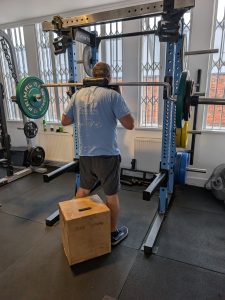
There’s no need to stop training completely – plenty of other exercises are just fine with a few adaptations if necessary
What about training the affected shoulder?
This is where restraint is useful.
The NHS recommends continuing to move the shoulder gently rather than simply stopping using it, while physiotherapy commonly includes mobility and strengthening work.
Exercise research also broadly supports exercise as part of frozen shoulder management. A 2022 systematic review found improvements in range of movement, function, pain and strength across exercise-based programmes, although the researchers could not identify one clearly superior exercise programme or ideal dose.
That last point is most interesting, and shows there isn’t a magic frozen shoulder routine.
And harder stretching isn’t automatically better stretching. One older but interesting study compared intensive passive stretching and mobilisation with a much gentler approach where exercises stayed within the person’s pain limits. At two years, the gentler group actually had better outcomes. It is only one study and shouldn’t be treated as the final word on rehabilitation, but it certainly doesn’t support the idea that an angry frozen shoulder needs to be aggressively forced into range.
Our approach would therefore normally be to keep the shoulder moving within a tolerable range, gradually expose it to more movement and resistance, and judge progression by how the shoulder responds rather than by how much discomfort somebody is prepared to tolerate – so, basically, intelligent strength training.
A little discomfort is not necessarily a failed session
Pain is where people understandably become cautious.
There is a difference between an exercise producing some mild discomfort around a stiff shoulder and repeatedly provoking it to the point that it becomes significantly more painful for the rest of the day or disturbs your sleep that night.
Rather than using an arbitrary pain score for everybody, we would look at the response.
Did the exercise settle quickly afterwards? Is the shoulder substantially more painful that evening? Has night pain become worse? Have you lost movement the following morning?
If an exercise repeatedly creates a significant flare-up, there isn’t much benefit in proving that you can tolerate it.
Change the exercise, reduce the load, shorten the range or temporarily take it out.
As the shoulder becomes less irritable, we can gradually ask more from it.
When would we start loading it properly again?
There is no single week where somebody suddenly graduates from rehabilitation back into ‘proper’ training.
The transition should be gradual.
If someone can move through a useful range without provoking a significant reaction, resistance can start to increase. As that becomes comfortable, we can expand the range. Eventually exercises that were initially removed can begin to return.
You might move from a light cable movement to a machine press, from a limited pressing range to a larger one, and eventually back towards dumbbells or barbells if those are exercises you actually want to do.
The aim isn’t simply to restore a textbook range of movement. It is to restore enough movement, strength and confidence for the things that matter to that person.
For one client that might mean being able to put a coat on comfortably, for somebody else it might mean getting back to tennis., for another it might mean pressing a barbell overhead again.
Those are different rehabilitation targets.
What about steroid injections, physiotherapy and surgery?
Strength training isn’t a replacement for medical treatment.
If the shoulder is extremely painful, significantly restricted or simply isn’t improving, physiotherapy or medical assessment is sensible.
There is reasonable evidence that an intra-articular corticosteroid injection can improve pain and function in the shorter term, particularly earlier in the condition. A large systematic review involving 65 studies found corticosteroid injection was the intervention with the clearest clinically meaningful short-term advantage compared with alternatives, although that advantage does not mean everybody needs an injection.
For more persistent frozen shoulder, options can include structured physiotherapy, manipulation under anaesthetic and arthroscopic capsular release.
The major UK FROST trial compared those three approaches in 503 people. After 12 months all groups had improved and there was no clinically important difference between the treatments. Surgery also brought greater cost and some additional risk.
So there isn’t one treatment that everybody with a frozen shoulder needs to rush towards.
How long does frozen shoulder take to recover?
Unfortunately, this is usually measured in months rather than weeks.
The NHS states that frozen shoulder can last months or sometimes years.
Older descriptions often suggested people simply went through the three classic stages and eventually recovered completely.
The evidence is less certain than that.
A systematic review looking specifically at the natural history found that improvement without treatment does happen, but complete spontaneous recovery in every patient isn’t well supported by the available evidence.
That doesn’t mean your shoulder is going to stay frozen. It just means there isn’t much point promising somebody that it will definitely be completely normal again in a particular number of months.
Can you still make progress in the gym while your shoulder recovers?
Absolutely.
This is probably the part people forget.
If a frozen shoulder takes many months to improve, putting your entire fitness programme on hold for that period makes very little sense. There may be exercises you can’t currently do. There will almost certainly be exercises you still can.
Good coaching means separating those two things.
We can maintain leg strength, muscle mass, cardiovascular fitness and general training habits. We can usually maintain at least some upper-body training. We can gradually increase what the affected shoulder does as its tolerance improves.
The goal isn’t to ignore the shoulder, but it isn’t to attack it either.
It’s to keep as much of your normal physical capacity as possible while giving the shoulder the time and appropriate loading it needs.
When should you get your shoulder assessed?
If pain and stiffness are persisting, passive movement is clearly becoming restricted, night pain is significant or you’re simply not sure what you’re dealing with, get it assessed.
The same applies if progress has stalled for a prolonged period despite sensible management.
And if the problem began with significant trauma, the arm suddenly became very weak, you have numbness or neurological symptoms, the joint looks different, or you develop severe unexplained pain, don’t rely on an internet article to decide what it is.
At Real World Fitness we can adapt training around a diagnosed shoulder problem and progressively rebuild strength as it improves.
We don’t diagnose frozen shoulders.
If the diagnosis is unclear, that part belongs with an appropriate medical or physiotherapy professional first.
Once we know what we’re working with, the gym becomes much easier to manage.
Frozen Shoulder FAQs
How can I tell if I have frozen shoulder?
The classic feature is substantial restriction of both active and passive shoulder movement, with external rotation particularly affected. Pain, stiffness and night pain are also common. An examination by a GP, physiotherapist or other appropriate clinician is the best way to confirm the diagnosis.
If somebody else can move my arm normally, is it frozen shoulder?
It would be less typical. A genuine frozen shoulder usually restricts passive movement as well as movement you produce yourself. A painful shoulder with relatively normal passive range may point towards another cause such as rotator cuff related pain.
Can I still go to the gym with frozen shoulder?
In most cases, yes. There is usually no reason to stop training your entire body. Exercises that aggravate the shoulder can be altered or temporarily removed while unaffected areas continue to be trained.
Should I stretch a frozen shoulder as hard as possible?
No. More aggressive stretching is not automatically more effective, particularly when the shoulder is highly painful and irritable. Movement and exercise should normally be progressed according to symptoms and tolerance.
Should I avoid weights completely?
Not necessarily. Appropriate resistance exercise can form part of rehabilitation, but exercise choice, range and load need to reflect what the shoulder can currently tolerate.
Will frozen shoulder definitely go away on its own?
Most people improve substantially, but the idea that every frozen shoulder inevitably passes through predictable stages and returns completely to normal without treatment isn’t supported particularly well by research.
Book your free Personal Training session today
If you’re in Nottingham and thinking about working with a personal trainer, this is the perfect opportunity to see what professional coaching can do.
Book your FREE personal training session and discover how expert guidance, a structured plan and genuine accountability can help you build strength, improve your fitness and achieve lasting results.
There’s no pressure and no hard sell. Just the opportunity to experience personal training for yourself, ask questions and see how we work.
After one session, you’ll know whether we’re the right gym, the right coach and the right approach for you.
Sign up to the RWF newsletter

