

How Strong Do You Need to Be for HYROX?
Watch a HYROX event from a casual gym-goer standpoint and it is easy to come away thinking that strength must be one of the biggest determinants of how well you do.
There are heavy sleds to push and pull, kettlebells to carry, sandbag lunges and 100 wall balls waiting for you at the end. It certainly isn’t an ordinary running race.
But nor is it really a strength competition.
HYROX sits somewhere between endurance sport and strength-based conditioning (the very name implies a hybrid fitness style), and that distinction matters when you decide how to train for it. Being stronger will absolutely help. The question is how strong you actually need to become, and whether adding another 20kg to your squat is really the best use of your training time.
The research we have so far suggests the answer is probably not as simple as many gym-goers expect.
What do you actually have to do in a HYROX?
The format is deliberately standardised. You complete eight 1km runs, with a workout station between each one.
For an Open Men’s individual event, those stations currently include a 152kg sled push, 103kg sled pull, 200m farmer’s carry with two 24kg kettlebells, 100m of lunges with a 20kg sandbag and 100 wall balls with a 6kg ball. There is also 1,000m on both the SkiErg and rower, plus 80m of burpee broad jumps.
For Open Women, the equivalent loads are 102kg for the sled push, 78kg for the pull, two 16kg kettlebells, a 10kg sandbag and a 4kg wall ball.
Those aren’t trivial loads, particularly when they are being performed between kilometres of running. But they are also not tests of maximum strength.
That is probably the first important point to understand.
A 152kg sled sounds heavy, but pushing a weighted sled is not comparable with squatting 152kg. Friction, flooring, the sled itself, technique and body position all affect the amount of force required. The farmer’s carry is difficult because you are carrying the kettlebells for 200 metres while already fatigued, not because picking up 48kg is an exceptional display of strength.

Throwing a reasonably light ball at a wall isn’t hard in isolation – but after running and lunging, even simple things are going to feel tougher
HYROX repeatedly asks you to produce force while tired. That is rather different from asking you to produce as much force as possible once.
HYROX probably involves more running than you think
One of the first studies to look specifically at HYROX was published in 2025 by researchers at the University of the Bundeswehr Munich.
It was a very small study, involving just 11 recreational HYROX athletes, so we need to be sensible about how much we read into it. However, it gives us some useful information about the demands of the event.
The athletes completed a simulated Open HYROX in a median time of 86.5 minutes. Of that, 51.2 minutes were spent running, compared with 32.8 minutes completing the workout stations.
Faster overall times were associated with a higher VO₂ max and a greater amount of endurance training. Interestingly, the researchers characterised HYROX as a running-focused form of high-intensity functional fitness, with relatively modest maximum-strength requirements compared with some other forms of functional fitness competition.
A much larger study published in July 2026 gives us an even better picture.
Researchers analysed 39,696 results from PRO and ELITE HYROX competition over the first seven competitive seasons. Running consistently accounted for around half of total race time, and improvements in race performances over the years were driven predominantly by competitors becoming faster runners.

HYROX involves much more running than most people realise – and it’s where strength athletes are going to need to put more effort in training
Running performance also corresponded more closely with overall race ranking than the individual strength-based stations did.
That doesn’t mean strength doesn’t matter. The same analysis found meaningful contributions from the strength-based exercises, particularly among slower competitors.
It does, however, suggest that someone approaching HYROX primarily as a strength event may be training for the wrong thing.
You need to be strong enough
There is obviously a point below which strength becomes a major limiting factor.
If getting the sled moving requires something close to your maximum effort, every length is going to take a lot out of you. If carrying two 24kg kettlebells is close to the limit of your grip and upper-body strength, 200 metres is going to be a very different proposition than it is for someone who handles that weight comfortably.
Getting stronger creates a reserve. If a competition load represents a smaller percentage of what you are capable of producing, you can generally deal with that load more comfortably. You are less likely to grind through every movement and you have more capacity left for everything that follows.
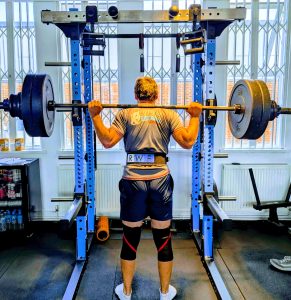
A great squat or deadlift will definitely help, and being strong already is a big advantage over someone who is only CV-fit
This is one of the reasons traditional strength training still has an important role in preparing for HYROX, but there is a difference between getting strong enough that strength is no longer a major weakness and simply trying to become as strong as possible.
More strength isn’t always the answer
Imagine two men entering an Open HYROX.
One struggles to squat his own bodyweight and has never carried anything heavier than a pair of 16kg kettlebells. Building his basic strength is likely to make a significant difference. The competition loads are simply too close to his current capabilities.
The other comfortably squats 180kg, carries heavy dumbbells regularly and has years of strength training behind him. Taking his squat from 180kg to 200kg might be a nice achievement, but it is difficult to argue that this should automatically be his priority for HYROX.
If he is losing minutes across the eight kilometres of running, that is probably where the larger opportunity lies.
This is where training needs to become specific to the individual rather than to the event.
There isn’t a scientifically established squat, deadlift or bench press number that suddenly means you are ‘strong enough for HYROX’. You will see suggested strength standards online, but they should be understood as coaching guidelines rather than proven thresholds.
I wouldn’t tell somebody that they must squat 1.5 times their bodyweight before entering HYROX, for example. The evidence simply isn’t there to support a number that precise.
What actually matters is whether your strength levels are limiting your performance.
Strong people can still be bad at HYROX
This is something traditional gym-goers can underestimate.
A reasonably strong person might look at a pair of 24kg kettlebells and think nothing of them. Twenty-kilogram lunges don’t look particularly frightening either.
Then put them after several kilometres of running, some SkiErg work, two sled stations, burpees and rowing, and they become a different exercise.
The ability to perform a good set of squats when rested does not automatically mean you will move efficiently when your heart rate is high and your legs have already accumulated 45 minutes of work.
HYROX rewards the ability to keep producing submaximal efforts over a relatively long period of time, which means strength endurance, aerobic fitness, pacing and recovery between efforts all matter.
It is perfectly possible to be the strongest person in your friendship group and still be comprehensively beaten at HYROX by someone who is weaker but runs substantially better and manages fatigue more effectively.
Running needs to be taken seriously
This is perhaps the least exciting message for someone coming to HYROX from a weights background, but probably the most important.
You are going to run eight kilometres.
More importantly, you aren’t running a fresh eight kilometres. You repeatedly have to settle back into a predictable running pace after completing a demanding exercise station.
The latest performance research makes a pretty compelling case that running isn’t something to bolt onto the end of a HYROX programme. It is one of the central components of it.
That doesn’t mean every run needs to be fast or that every session needs to involve intervals. As with most endurance training, there is value in building enough general running volume, having easier aerobic work, improving the pace you can sustain and including harder work where appropriate.
Someone with a solid strength background who signs up for a HYROX may therefore need to spend considerably more of their available training time running than they initially expect.
For somebody coming from running, the opposite might be true. Their engine may already be good enough while the sled, carries and lunges expose an obvious lack of strength.
Again, train the person rather than the event.
Don’t turn every training session into a HYROX simulation
Once someone has entered an event, there can be a temptation to make every workout look like the competition.
Run. Sled. Burpees. Row. Lunges. Run again.
It feels specific, and it certainly feels hard, but reproducing the race repeatedly isn’t necessarily the best way to improve all of the qualities needed to perform it, just like a powerlifter shouldn’t treat every training session as a mini-competition.
There is still a place for fairly ordinary strength training. Squats, split squats, hinges, rows, presses and loaded carries can build strength much more effectively when they are trained with enough rest and sensible progression than when they are permanently buried halfway through a conditioning circuit.

Not every session needs to leave you destroyed. You don’t need to train the whole event every time you set foot in the gym.
Running also deserves training in its own right.
Then there is the HYROX-specific work: learning how hard you can push a sled without ruining the next run, practising wall balls under fatigue, becoming efficient on the SkiErg and rower, working on transitions and discovering what pace you can actually sustain for the whole event.
Those three things overlap, but they aren’t identical. As the competition gets closer it makes sense for training to become more specific. You need some experience of how the stations feel when you are already tired, and nobody should discover how a HYROX sled feels for the first time on race day.
But spending months doing nothing except race simulations can leave obvious gaps in both strength and endurance development.
Strength endurance isn’t the same as strength
This distinction is particularly important with exercises such as lunges and wall balls.
If you can’t perform a controlled lunge with a 20kg sandbag when fresh, you probably need to become stronger.
If you can comfortably perform one, but your legs are burning after 40 metres and you have to stop repeatedly, your problem isn’t necessarily maximum strength.
Likewise, being capable of squatting much more than the load involved in a wall ball doesn’t guarantee that you can produce 100 good repetitions after everything else in the race.
Simply adding more weight to your strength exercises may not solve that. At some stage you need to practise sustaining force repeatedly and doing so while fatigued.
Good HYROX preparation therefore needs both a strength base and the ability to use that strength for much longer than a normal set of five or eight repetitions.
So how much strength training should you do?
There isn’t one programme that will suit everyone.
For a reasonably experienced recreational competitor, two well-designed strength sessions each week may be plenty to build or maintain the necessary strength while leaving enough training capacity for running and HYROX-specific work.
Someone who is currently quite weak might temporarily need more emphasis on strength. A very strong gym-goer with poor endurance probably doesn’t.
Training age matters too. An experienced lifter may maintain strength surprisingly well on fairly modest training volume while concentrating on running. A beginner who is still learning basic movement patterns is in a different position.
The mistake is deciding that because HYROX includes weights, more strength training must always be better. Your programme needs to address what is actually holding you back.
Do you need a HYROX gym to prepare for HYROX?
You need access to enough of the relevant equipment to practise the specific stations at some point, particularly the sled.
That doesn’t mean every training session has to take place in an official HYROX training club.
A lot of the physical preparation can be developed in a well-equipped conventional gym. Strength can be built with normal resistance training. Running can be done outside or on a treadmill. Carries, lunges, rowing and SkiErg work aren’t unique to HYROX either.
The sled is the obvious exception because technique and surface make a noticeable difference to how it feels. If you are entering a HYROX, getting some genuine practice on an appropriate sled before the event is sensible.
At Real World Fitness in Nottingham, our role would be more towards helping someone build the strength side of their preparation rather than pretending that every gym session needs to become a HYROX class.
Preparing for your first HYROX
If this is your first event, you don’t need to turn yourself into an elite endurance athlete or competitive powerlifter before entering.
If you already run but barely strength train, start building basic strength well before the event. Learn to squat and lunge properly, develop your pulling and carrying strength and get some experience of the actual competition movements.
If you already lift weights but rarely run, don’t assume general gym fitness will carry you through eight kilometres comfortably. Start running early enough that you can build your volume gradually rather than trying to cram running fitness into the final few weeks.
And whichever direction you’re coming from, practise some sessions that combine the two before race day.
You need to know what your running pace feels like after a sled push. You need to know whether you can still perform decent wall balls when you’re tired. You need to know which stations tempt you to go too hard.
That is not knowledge you’re going to want to find out a week before race day when it’s too late to make any adaptations.
How strong do you really need to be for HYROX?
Probably strong enough that the competition loads don’t dominate the race. Beyond that, the answer becomes much more individual.
If strength is clearly your weakness, becoming stronger could transform your HYROX performance. If you already have a substantial strength reserve, continuing to chase bigger gym numbers may produce increasingly small benefits compared with improving your running, conditioning, technique and pacing.
The emerging research on HYROX points in much the same direction. Strength matters, but this is an endurance-heavy event in which approximately half of the competition is spent running.
The best preparation therefore isn’t to choose between strength and cardio, it is to work out which one you currently need more of.
Frequently Asked Questions
Do you need to be strong for HYROX?
You need enough strength to handle the fixed competition loads efficiently, but HYROX isn’t a maximum-strength competition. Once you have a reasonable strength reserve, running ability, conditioning and strength endurance may become more important areas to improve.
Is HYROX more cardio or strength?
It requires both, but current research suggests it is more endurance-focused than its appearance might suggest. Running accounts for approximately half of competition time, and running performance is strongly associated with overall HYROX performance.
Should I still lift weights while training for HYROX?
Yes. Strength training can make the fixed competition loads relatively easier and helps maintain the strength required for sleds, carries and lunges. The amount you need depends on your existing strength and how much time also needs to be devoted to running and specific HYROX preparation.
How many strength sessions a week should I do for HYROX?
There is no universal number, but two good strength sessions a week can be sufficient for many recreational competitors. Someone with a low strength base may need more emphasis on strength, while an experienced lifter may be able to maintain what they need with less.
Do I need a sled to train for HYROX?
Not for every training session, but you should practise the actual sled push and pull before competing. Sled resistance feels very different from conventional weight training and varies depending on the sled, surface and technique.
Book your free Personal Training session today
If you’re in Nottingham and thinking about working with a personal trainer, this is the perfect opportunity to see what professional coaching can do.
Book your FREE personal training session and discover how expert guidance, a structured plan and genuine accountability can help you build strength, improve your fitness and achieve lasting results.
There’s no pressure and no hard sell. Just the opportunity to experience personal training for yourself, ask questions and see how we work.
After one session, you’ll know whether we’re the right gym, the right coach and the right approach for you.
Sign up to the RWF newsletter

