
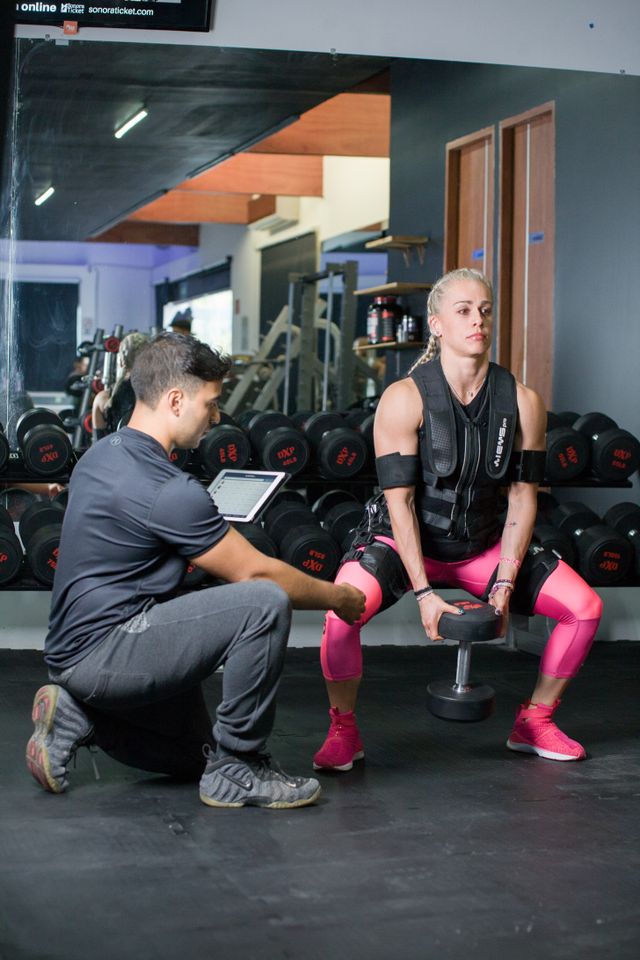
Weighted Vests Are Everywhere. Do They Actually Work?
Weighted vests have been around for years. They’ve been used in military training, CrossFit, sports conditioning and various forms of rehabilitation. What’s changed recently is who they’re being marketed to, and what they’re supposed to be doing.
They’ve suddenly become a fairly significant fitness trend, particularly among women in their 40s, 50s and beyond. Social media is full of people wearing them while walking, and the claims tend to go well beyond simply making a walk a little harder. Weighted walking is now being promoted as a way to build muscle, strengthen bones, improve metabolism and, particularly around and after menopause, potentially replace some of the benefits of more traditional strength training.
The trend has become big enough that Women’s Health has published several features on weighted vests during 2026 alone. The Guardian and Telegraph have published many features, including this one. The Washington Post reported that one major weighted-vest manufacturer had seen sales rise by almost 140% since 2023, while another reported its vest sales doubling annually.
So, are we all missing something? Can you really turn your normal walk into a strength workout simply by adding a few kilograms around your torso?
There’s some good news, and, predictably, some absolute nonsense to filter through.
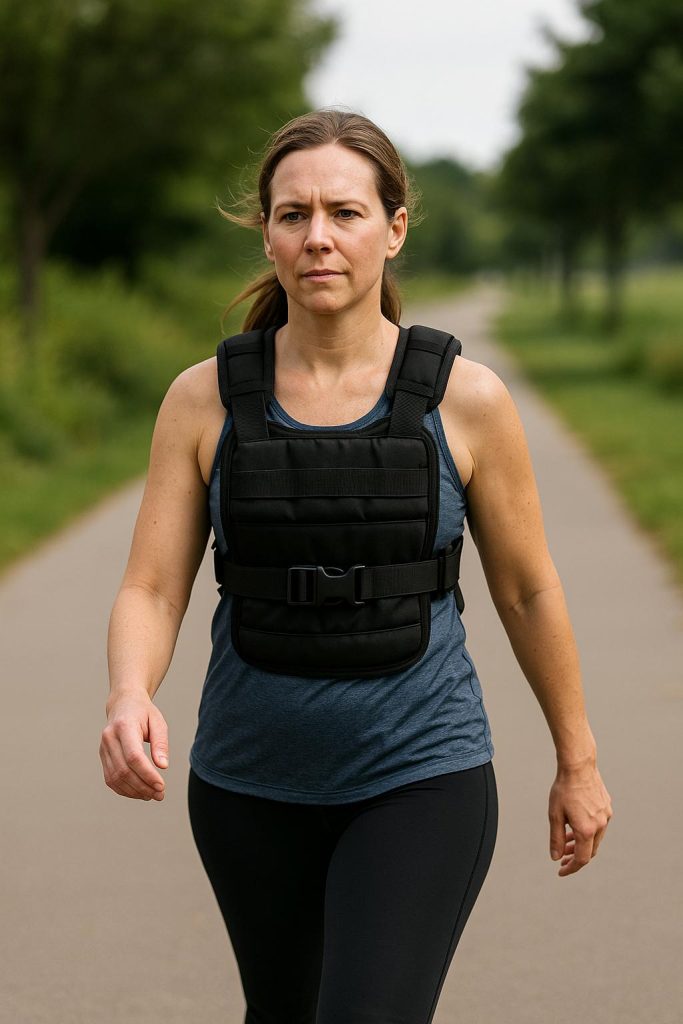
A weighted vest added to a walk has become a fitness darling – but does it do anything in terms of strength training?
A Weighted Vest Definitely Makes Walking Harder
This bit isn’t really in dispute.
If you normally weigh 70kg and put another 7kg around your torso, your body now has to transport 77kg every time you take a step. That requires more energy.
Research has demonstrated this quite clearly. A 2006 study measured people walking on a treadmill wearing vests loaded with 0%, 10%, 15% and 20% of their bodyweight. As the load increased, oxygen consumption increased, exercise intensity increased and the forces passing through the body increased.
A much more recent 2024 study looked specifically at the metabolic cost of carrying weight in a vest. Again, there was a clear relationship between external load and the amount of energy required to walk. Put more weight on someone and, unsurprisingly, moving them around becomes more energy expensive.
Another trial using the sort of weighted vests commonly seen in CrossFit found increases in oxygen consumption, heart rate and energy expenditure when participants ran wearing them. During uphill walking, the vest also increased the physiological demand.
So if somebody enjoys walking and wants to make the same route more physically demanding, I don’t have an argument with that.
Put a vest on, walk up a hill and it will be harder. That is a perfectly legitimate use for one. You’ll burn a few more calories.
The more interesting question is what happens when we start getting a bit over-excited, and calling that strength training.
Does Weighted Walking Build Muscle?
Potentially a little, depending on who you are and what you were doing beforehand.
But that’s a very different statement from saying weighted walking is a good substitute for resistance training.
Muscle responds to sufficient mechanical tension and, importantly, that stimulus normally needs to progress as you adapt. In a gym we can increase the load, perform more repetitions, change exercises and train different muscle groups through different ranges of movement.
Walking with another 5kg attached to you simply doesn’t provide the same stimulus.
Your calves, quads, glutes and other muscles involved in walking will certainly have slightly more work to do. For somebody starting from a very low level of physical activity, that may be enough to produce some adaptation.
But your chest hasn’t suddenly received a training stimulus. Neither have your upper back, shoulders or arms to any meaningful degree. Even your legs are repeatedly performing essentially the same relatively low-force movement.
And we now have a particularly useful study that directly compared weighted-vest use with proper resistance training.
Weighted Vests Versus Resistance Training
The INVEST in Bone Health trial followed 150 adults with an average age of around 66. Three quarters of them were women. The participants were trying to lose approximately 10% of their bodyweight.
They were divided into three groups.
One lost weight through calorie restriction. Another did the same but wore a weighted vest. The third combined weight loss with supervised progressive resistance training three times per week.
The vest group weren’t exactly lazy about it either. They reported wearing the vest for an average of 7.1 hours per day over the 12-month study, with weight progressively added to replace much of the bodyweight they were losing.
Researchers have since analysed the muscle results from that trial.
The resistance-training group actually increased mid-thigh muscle cross-sectional area slightly despite losing around 10% of their bodyweight. They also improved muscle density and substantially reduced fat stored between the muscles.
The weighted-vest group showed a possible benefit in preserving some trunk muscle, but overall the differences between wearing the vest and weight loss alone were not statistically significant for most of the muscle measurements.
The researchers’ conclusion was that progressive resistance training was the more effective strategy for preserving or improving muscle during weight loss.
That’s really quite important.
This wasn’t someone wearing a 3kg vest twice a week while walking the dog.
These people averaged more than seven hours a day in one for a year, yet the muscular response still wasn’t anywhere near equivalent to progressive resistance training.
What About Bone Density?
This is where weighted vests are probably being marketed most aggressively to women around menopause, and there is a sensible idea underneath it.
Bone responds to mechanical loading. We know that resistance training and appropriate impact exercise can be useful for maintaining or improving bone strength. A weighted vest increases the load passing through the skeleton, so it isn’t unreasonable to ask whether wearing one might help.
There is also some research that appears encouraging.
One frequently cited study followed postmenopausal women who exercised using weighted vests over a period of five years. The women undertaking the programme maintained hip bone mineral density considerably better than the control group, which sounds fairly convincing.
But there’s an important detail. They weren’t just walking around wearing a vest. They were doing an exercise programme that included jumping while progressively loaded with the vest, three times per week (so basically, weighted plyometrics, a form of strength training).
Another nine-month study in postmenopausal women found significant improvements in lower-body strength, muscular power, balance and lean leg mass when weighted vests were used. Again, however, the programme involved progressive lower-body exercises specifically designed to develop strength and power. The vest was being used as the resistance for an exercise programme.
A 12-week trial also found improvements in some measures of strength, body composition and bone turnover when postmenopausal women exercised three times per week wearing progressively heavier vests, ultimately reaching loads of up to 15% of bodyweight. Once again, this was progressive exercise using a vest, not simply everyday walking with extra weight attached.
That distinction is really important.
A weighted vest can absolutely be a resistance-training tool. So can a barbell. But carrying a barbell to the shops isn’t the same as doing squats with it.
One of the Biggest Recent Studies Wasn’t Particularly Encouraging
Let’s go back to the INVEST trial, because bone health was actually its primary purpose.
Researchers wanted to know whether replacing lost bodyweight with an external load could prevent the reduction in bone density sometimes seen when older adults lose a significant amount of weight.
It’s a clever idea.
If somebody loses 10kg, their skeleton is now exposed to less loading during normal life. What happens if we gradually replace much of those 10kg with a vest?
After 12 months, all three groups had lost roughly 9 to 11% of their original bodyweight.
Unfortunately, hip bone density declined in all three.
The weighted vest did not significantly prevent the bone loss compared with weight loss alone.
Interestingly, neither did the resistance-training programme in this particular trial. That’s worth mentioning because it would be very easy for us, as a strength-training gym, to selectively quote the results that favour what we do and ignore the ones that don’t.
That doesn’t suddenly mean resistance training isn’t useful for bone health. A 2025 meta-analysis pooling 17 randomised trials and 690 postmenopausal women found that resistance training significantly improved bone mineral density at the lumbar spine, neck and hip, with higher-intensity training showing particularly useful results at some sites.
UK osteoporosis exercise guidance also recommends resistance and impact exercise to maximise bone strength, alongside strength and balance work to reduce falls.
What the INVEST trial does show is that bone biology is complicated, particularly during significant weight loss. Merely replacing the lost weight with a vest isn’t a guaranteed solution.
The Latest Review Probably Gives Us the Best Answer
A 2026 review pulled together 15 studies examining weighted-vest use in adults aged 60 and over.
Its findings are almost exactly what we’d expect from looking at the individual studies.
When weighted vests were incorporated into specific exercises and progressively loaded training programmes, researchers sometimes found improvements in muscular performance and bone-related outcomes.
When people simply wore relatively light weighted vests without a structured progressive exercise programme, meaningful improvements in musculoskeletal health were much harder to demonstrate.
The researchers described these as two quite different approaches: effectively wearing a vest versus training with a vest.
That’s probably the most useful distinction in this whole discussion.
Wearing Weight and Training With Weight Aren’t the Same Thing
Imagine two women who are both 55.
The first walks for 45 minutes most days, puts a 5kg vest on and continues walking exactly as before.
The second trains twice per week. She squats, pushes, pulls, hinges, carries and performs exercises appropriate to her ability. Over the following months those exercises gradually become more challenging as she gets stronger.
Both are carrying external resistance, but they aren’t even slightly doing the same thing.
The second person has much greater control over which muscles are being trained, how hard they’re being asked to work, what range of movement is being used and how that stimulus progresses.
That’s the fundamental principle that gets lost when people start presenting weighted walking as an alternative to strength training.
The issue isn’t that 5kg is somehow ineffective because it comes in the shape of a vest.
The issue is what you’re actually doing with that 5kg.
Could a Weighted Vest Still Be Useful?
Absolutely.
If you already walk regularly, adding some load could be an easy way of making certain walks harder without having to walk faster or dramatically increase the distance. Hills become harder. Stairs become harder. Your cardiovascular demand rises. You’re carrying a little more load through every step.
For somebody who enjoys hiking, there may also be a fairly obvious crossover to carrying a backpack in the real world.
They can also be useful as an actual resistance-training tool. Squats, step-ups, split squats, calf raises and other bodyweight movements can all be made progressively harder by adding a vest. For people training at home, that can be extremely convenient.
There are even some older studies showing improvements in balance, strength and power when vests have been used in exactly that way.
What I wouldn’t do is buy one because somebody on Instagram has suggested that walking in it gives you the same benefits as properly programmed strength training, because that’s (as we’ve evidenced above) nonsense.
The evidence simply doesn’t support that claim.
Is More Weight Always Better?
No.
The 2026 review also highlighted the need for sensible progression and individual assessment rather than simply loading people up as heavily as possible. Some studies reported usability problems and generally mild adverse effects, while one trial recorded a higher number of falls in the weighted-vest group.
That matters particularly when the very people being heavily marketed these products are sometimes older adults concerned about osteoporosis, balance or previous injuries.
Adding external load changes the demands of an activity, and normally that’s precisely why we’re doing it.
But it also means it should be treated as exercise, rather than assuming that because something looks like walking it must automatically be suitable for everybody.
Someone with osteoporosis, a history of fractures, significant balance problems or persistent joint or back pain may need the type and amount of loading adjusted appropriately.
So, Do Weighted Vests Work?
Yes.
They make walking harder. They increase energy expenditure. They increase the load being carried by the body.
They can be a convenient way of progressing certain exercises, and when they’re incorporated into a structured exercise programme, there’s evidence that they can contribute to improvements in strength, power, balance and potentially bone health.
That’s a pretty decent list of benefits.
What they aren’t is a magic shortcut that transforms an ordinary walk into a complete strength-training programme, regardless of your favourite influencer (who’s pocketing. a few quid on a referral code for every one they persuade a follower to buy) promoting the opposite.
If you enjoy walking, keep walking. If putting a weighted vest on occasionally makes that walk more challenging and you enjoy doing it, that’s fine too.
But if your goal is to become stronger, maintain muscle as you get older and give your bones an appropriate training stimulus, we’d still put progressive resistance training at the centre of the programme.
Book your free Personal Training session today
If you’re in Nottingham and thinking about working with a personal trainer, this is the perfect opportunity to see what professional coaching can do.
Book your FREE personal training session and discover how expert guidance, a structured plan and genuine accountability can help you build strength, improve your fitness and achieve lasting results.
There’s no pressure and no hard sell. Just the opportunity to experience personal training for yourself, ask questions and see how we work.
After one session, you’ll know whether we’re the right gym, the right coach and the right approach for you.
Sign up to the RWF newsletter

