
Fall Prevention: How to Stay Strong, Steady and Independent as You Age
Most people don’t spend much time thinking about falling until it happens.
For younger people, a slip on an icy pavement or a missed step is often little more than an inconvenience. As we get older, the consequences can be very different. A fall that would once have resulted in nothing more than a bit of bruised pride can become a broken wrist, a fractured hip or the beginning of a gradual loss of confidence and independence.
The reassuring news is that many falls aren’t simply bad luck. While nobody can eliminate the risk entirely, there is a great deal you can do to stack the odds in your favour.
In many cases, preventing falls has less to do with practising balance exercises and far more to do with staying physically capable.
Why do falls become more common with age?
It’s tempting to think that balance simply disappears as we get older, but that’s only part of the issue.
Most falls happen because several small changes occur at the same time. Muscles become weaker. Reaction times slow slightly. We move a little less than we used to. Joints become stiffer and confidence gradually fades. None of these changes is necessarily dramatic on its own, but together they make recovering from an unexpected stumble much more difficult.
That’s why a loose paving slab, an uneven path or the family dog running between your feet suddenly becomes a much bigger problem than it would have been twenty years earlier.
The encouraging part is that many of these changes respond remarkably well to exercise.
Strength is your first line of defence
When people think about preventing falls, they often imagine standing on one leg or wobbling on a balance board.
Those exercises certainly have their place, but they’re only part of the solution.
Imagine catching your toe on the edge of a kerb. You have a split second to stop yourself hitting the ground. Your body doesn’t rely on balance alone. It relies on strong legs, strong hips and muscles that can react quickly enough to pull you back into position.
In other words, strength gives balance something to work with.
This is one of the reasons resistance training is so valuable as we get older. It helps maintain the muscles that allow us to climb stairs comfortably, get out of chairs without using our hands, carry shopping with confidence and recover when life inevitably throws a random stumble at us.
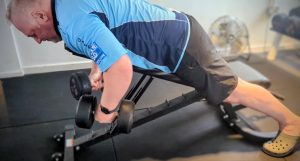
RWF Personal Training Client Paul learning some prone dumbbell row technique
Balance isn’t something you’re born with
People often describe themselves as having ‘good balance’ or ‘bad balance’, as though it’s a personality trait.
In reality, balance is a skill. Like strength, it improves when you challenge it regularly.
Simply spending more time moving, walking, changing direction, stepping over obstacles and performing everyday tasks confidently all help maintain your balance. Specific balance exercises can also be useful, particularly for people who have already noticed themselves becoming less steady.
The biggest improvements usually come when strength and balance are trained together rather than separately.
Confidence matters more than many people realise
One of the hidden consequences of falling is fear.
Someone has a fall, becomes understandably anxious about it happening again and gradually starts doing less. They stop taking longer walks, they begin to avoid stairs, as a result, they become less and less active. Unfortunately, the less we move, the weaker we become. As strength declines, balance often deteriorates further, making another fall even more likely.
Breaking that cycle early is incredibly important.
Looking after your bones as well as your muscles
Strong muscles reduce the chance of falling. Strong bones reduce the worst consequences if you do.
That’s why strength training is so valuable; it supports both.
Resistance exercise helps maintain muscle mass while also placing healthy loads through the skeleton, encouraging the body to maintain bone strength. Combined with adequate protein, calcium and vitamin D, it forms one of the most effective long-term strategies for maintaining physical independence.
If you’ve already read our articles on sarcopenia, frailty or osteoporosis, you’ll recognise how closely these conditions are linked. Muscle, bone and balance all influence one another.
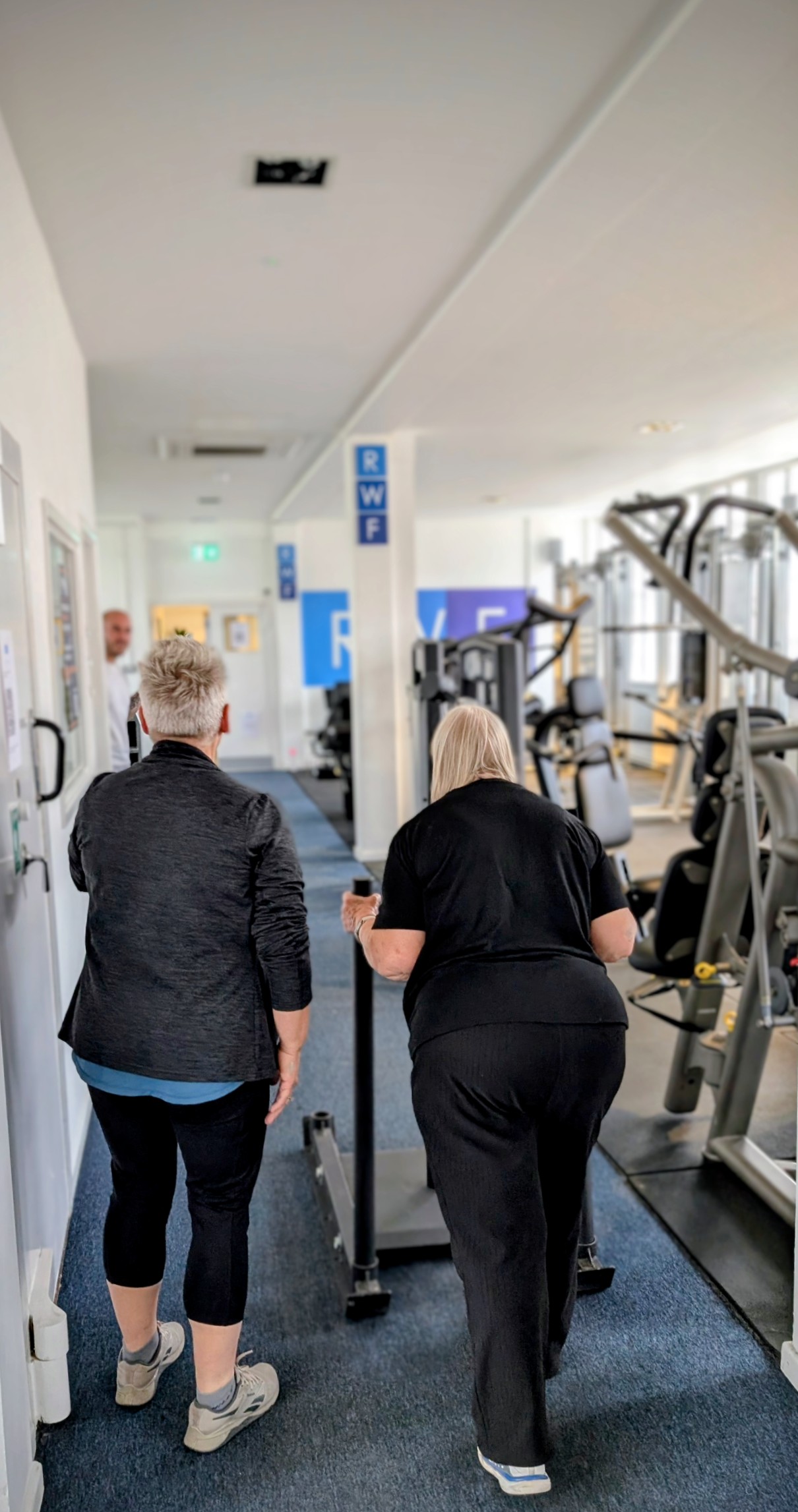
RWF PT Christine helping an older client learn to walk again
Staying capable for life
Most older people don’t join a gym because they want to improve their balance.
They join because they want to continue living life on their own terms. They want to travel without worrying about carrying a suitcase. They want to play with grandchildren, enjoy long walks, work in the garden or simply get up from the floor without needing assistance.
Falls prevention isn’t really just about falls, it’s about preserving the physical ability to keep doing the things that matter to you.
How Real World Fitness can help
Many of our older members don’t arrive with ambitions of lifting enormous weights or competing in strength sports.
They simply want to stay strong enough that everyday life continues to feel easy.
Our role is to help make that happen, and we’ve helped hundreds of people in this position over the last 20 years.
Every programme is built around the individual, taking into account current fitness, previous injuries, confidence and long-term goals. Progression is gradual, exercises are chosen carefully and the emphasis is always on building strength that transfers into everyday life.
Because we deliberately limit our membership numbers, you’ll never be trying to learn in an overcrowded gym. You’ll have the space, time and support to develop confidence at your own pace.
If you’re becoming less steady on your feet, worried about losing strength or simply want to stay active for many years to come, we’d be happy to help.
Book your free personal training session
If you’re in Nottingham and thinking about working with a personal trainer, this is the perfect opportunity to see what professional coaching can do.
Book your FREE personal training session and discover how expert guidance, a structured plan and genuine accountability can help you build strength, improve your fitness and remain capable for years to come.
There’s no pressure and no hard sell. Just the opportunity to experience personal training for yourself, ask questions and see how we work.
After one session, you’ll know whether we’re the right gym, the right coach and the right approach for you.
If you’ve spent years avoiding the gym because you think you’re too old, too stiff or too out of shape, you’re exactly the sort of person we work with every day.
Based in Nottingham, Real World Fitness offers a calm, friendly environment with expert personal training and a gym designed for people who want long-term results rather than quick fixes.
If you’d like to see what we’re about, get in touch or arrange a free 7-day trial.
Book your free Personal Training session today
If you’re in Nottingham and thinking about working with a personal trainer, this is the perfect opportunity to see what professional coaching can do.
Book your FREE personal training session and discover how expert guidance, a structured plan and genuine accountability can help you build strength, improve your fitness and achieve lasting results.
There’s no pressure and no hard sell. Just the opportunity to experience personal training for yourself, ask questions and see how we work.
After one session, you’ll know whether we’re the right gym, the right coach and the right approach for you.
Sign up to the RWF newsletter

